Eleanor Whitmore had spent twenty-eight years believing her father died without leaving her a final word.
Then, on a rainy Thursday evening, a stranger walked into the old family library carrying a photograph she had never seen.
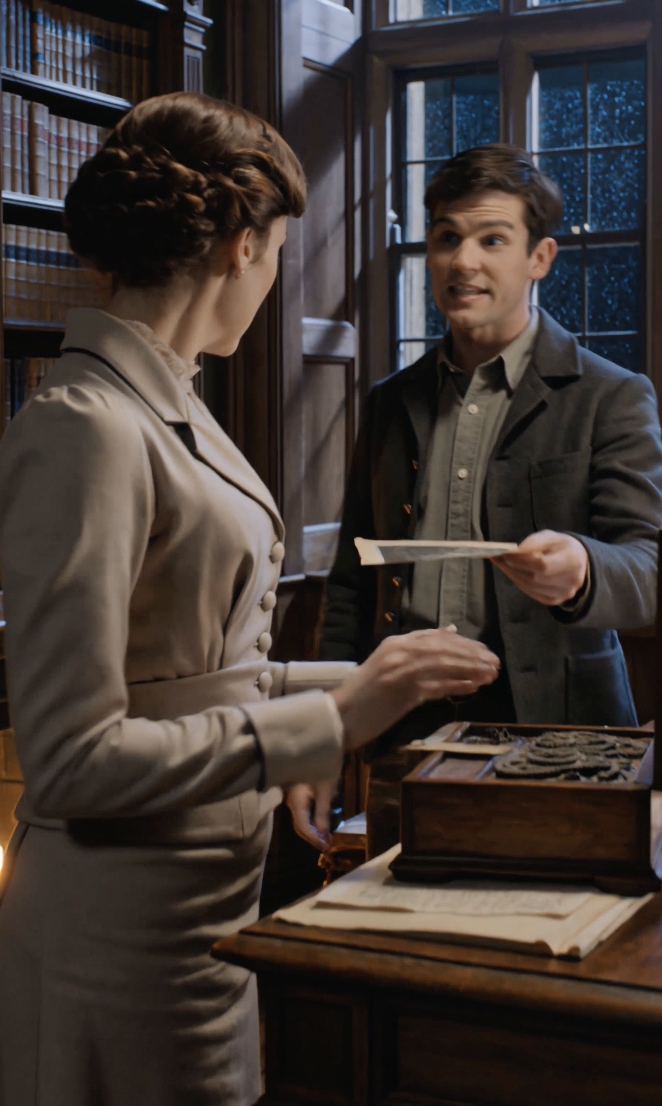
Eleanor was standing beside her father’s desk, sorting the last belongings before the house was sold.
At fifty-four, she had finally decided she could no longer keep the enormous country home outside Oxford simply because she was afraid to let go of the past.
Her husband had died six years earlier. Her daughter lived in Edinburgh with her own family. And most of the rooms had been closed for so long that Eleanor sometimes felt she was living inside a museum.
She was about to lock an old wooden box when she heard footsteps.
A young man stood in the doorway.
He looked about thirty.
“Mrs. Whitmore?”
“Yes?”
“My name is Daniel Reed. I think I have something that belongs to you.”
Eleanor stiffened.
“I’m afraid the house isn’t open to visitors.”
“I know.”
Daniel removed an old envelope from his coat.
“My mother asked me to bring this here after she died.”
He handed Eleanor a black-and-white photograph.
The moment she saw it, her fingers began to shake.
The photograph showed her father, Arthur Whitmore, standing beside a young woman Eleanor did not recognize.
Arthur was smiling.
Not the restrained smile he used in family portraits.
A real smile.
On the back, in his handwriting, were five words:
“For Margaret. Until I come back.”
Eleanor looked at Daniel.
“Who was your mother?”
“Margaret Reed.”
The name hit her like a distant echo.
Eleanor remembered hearing it only once as a child.
Her parents had been arguing behind a closed door.
Her mother had shouted:
“Margaret is gone, Arthur. Leave the past buried.”
Eleanor had never understood what it meant.
Until now.
Daniel reached into the envelope again.
“My mother kept this photograph for forty years. Before she died, she told me your father saved her life.”
Eleanor sat down.
Daniel explained that Margaret had worked as a secretary at Whitmore Engineering when she was nineteen.
One winter night, she discovered that a senior manager had been stealing money from employee pension accounts.
She told Arthur.
Instead of ignoring her, he helped collect evidence and protected her when the manager threatened to destroy her reputation.
But exposing the fraud created enemies.
Margaret left the company and moved north.
Years later, she married, raised a family and never contacted Arthur again.
Eleanor frowned.
“Then why did my mother hate hearing her name?”
Daniel hesitated.
“Because there was more.”
He pointed toward the wooden box on the desk.
“My mother said your father kept something inside it.”
Eleanor looked at the box.
She had found it that morning in the back of a cabinet.
It was beautifully made, with tiny brass gears visible beneath the lid.
But it was locked.
“I don’t have the key.”
Daniel looked toward the old photograph.
“Apparently, you do.”
Eleanor turned it over again.
Along the bottom edge was a faint handwritten line she had missed.
Look beneath the place where time stopped.
Her heart began to race.
There was only one thing in the library that sentence could mean.
A grandfather clock stood against the far wall.
It had stopped at 6:17 on the night Arthur died.
Eleanor had refused to repair it.
She crossed the room and opened the clock’s lower compartment.
Behind the pendulum was a small cloth pouch.
Inside was an ornate brass key.
For almost three decades, it had been there.
Waiting.
Eleanor returned to the desk and unlocked the box.
Inside were letters, financial documents and a sealed envelope bearing her name.
She opened that one first.
“My dearest Ellie,
If you are reading this, I failed to tell you something while I still had time.”
Eleanor covered her mouth.
The letter explained everything.
Margaret had never been Arthur’s lover.
She had been his younger half-sister.
Arthur’s father had secretly had another child years before marrying Eleanor’s grandmother.
After the man died, Arthur discovered Margaret’s existence and quietly helped her through school and later found her work.
Arthur had wanted to tell his wife.
But Eleanor’s mother, obsessed with the family’s reputation, feared scandal.
She demanded that Margaret disappear from their lives.
Arthur reluctantly agreed to keep the relationship private.
After Margaret uncovered the financial crimes at the company, Arthur helped her leave safely and continued supporting her from a distance.
The documents in the box proved something else.
Arthur had created a trust for Margaret and her children.
But he died before completing the final transfer.
Eleanor looked at Daniel.
“So your mother was my aunt.”
Daniel nodded.
“And that makes us family.”
For the first time that evening, neither of them knew what to say.
Eleanor spent the entire night reading.
There were dozens of letters from Arthur to Margaret.
Some were never sent.
In one, written shortly before his death, he said:
“I have spent too much of my life protecting appearances. Eleanor deserves to know that her family is larger than she thinks.”
Eleanor cried until morning.
Not because her father had betrayed her.
Because she finally understood how much he had carried alone.
The next day, she cancelled the sale of the house.
But she did not keep it as a shrine.
Instead, she and Daniel spent the following year restoring the library and organizing Arthur and Margaret’s papers.
The missing trust was legally resolved, and Eleanor insisted that Margaret’s grandchildren receive the money Arthur had intended for their family.
Daniel initially refused.
Eleanor simply told him:
“My father waited twenty-eight years for me to finish what he started. I’m not making him wait any longer.”
The old house eventually became a small historical and educational center funded by both sides of the family.
Daniel became its director.
Eleanor moved into a smaller cottage nearby and finally began traveling, something she had postponed for most of her adult life.
Her daughter met Daniel and his family that Christmas.
For the first time, their table was crowded.
The wooden box remained in the library.
So did the photograph.
And beside them was the brass key with a small plaque:
“Some doors are locked by secrets. Others are opened by truth.”
Eleanor had entered that room believing she was preparing to close the final chapter of her father’s life.
Instead, a stranger carrying an old photograph gave her something she thought she had lost forever.
Not an inheritance.
Not a house.
A family.