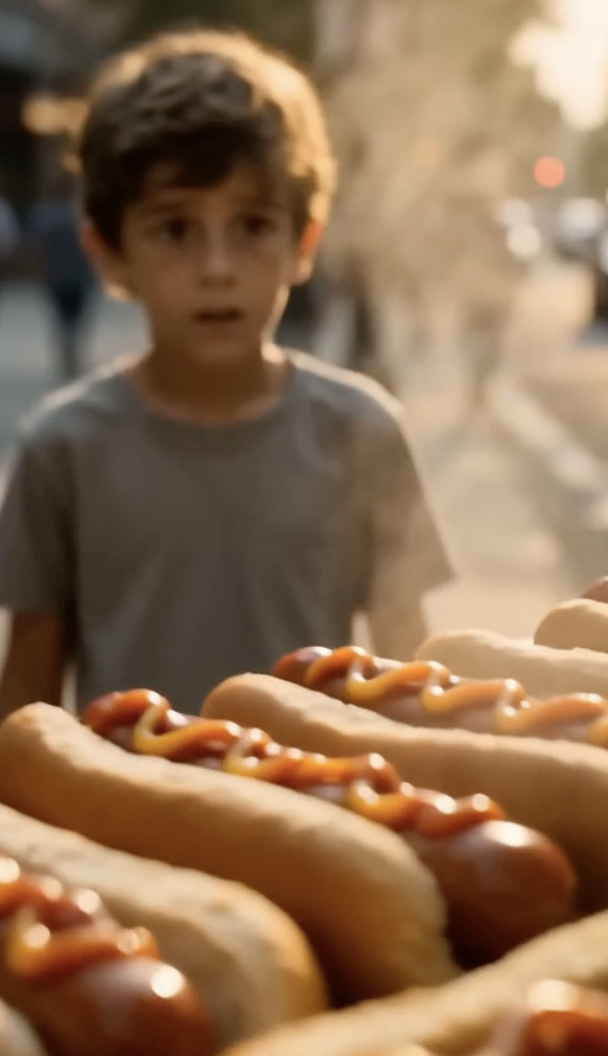
For seven years, Sarah Miller had opened her small food cart before sunrise.
By six every morning, the smell of grilled onions and hot dogs drifted along the busy Manhattan sidewalk. Office workers stopped for coffee, taxi drivers greeted her by name, and tourists sometimes took pictures of the little silver cart squeezed between enormous buildings.
Few of them knew why Sarah worked there.
Years earlier, she had lived a completely different life.
At twenty-four, Sarah had fallen in love with Daniel Carter, the only son of a wealthy New York businessman. Daniel wanted to become a teacher, but his father, Richard, expected him to join the family company.
When Daniel announced that he planned to marry Sarah, the relationship between father and son collapsed.
Richard believed Sarah was interested in the family’s money.
Daniel walked away from everything.
They married quietly and rented a tiny apartment.
For three years, they were happy.
Then Daniel was killed in a car accident.
Their son, Noah, was only six months old.
After the funeral, Sarah tried to contact Richard. She wanted Noah to know his grandfather.
Her letters were returned unopened.
Eventually she stopped trying.
She worked wherever she could, saved every dollar and finally bought the food cart.
By the time Noah was seven, Sarah had built a modest but stable life.
Every afternoon after school, Noah came to the cart and did his homework on a folding chair beside her.
He loved talking to customers.
That Tuesday seemed no different.
Noah was eating a hot dog when a long black car stopped beside the pavement.
A man in a dark suit stepped out.
Sarah immediately recognized him.
Richard Carter.
He looked older than she remembered. His hair had turned gray, and the confidence that once made everyone around him nervous seemed softer now.
Sarah froze.
Richard looked at Noah.
For several seconds he said nothing.
Then he turned to Sarah.
“Is that Daniel’s son?”
Sarah placed herself between them.
“His name is Noah.”
Richard swallowed.
“I didn’t know.”
Sarah laughed bitterly.
“You did. I wrote to you.”
Richard’s expression changed.
“What letters?”
He opened the leather folder in his hand.
Inside were copies of documents, old photographs and several envelopes.
Sarah recognized her handwriting immediately.
Her letters.
All unopened.
Richard explained that after Daniel’s death, his longtime assistant had handled most of his personal correspondence. Believing Sarah wanted money, the man had hidden every letter.
Richard discovered them only after the assistant retired.
There were fourteen.
Birthday photographs.
Christmas cards.
Updates about Noah’s first words, first steps and first day of school.
Richard had spent the previous week reading them over and over.
“I lost my son because I was too proud to listen to him,” he said quietly. “And then I lost seven years with his child.”
Sarah wanted to remain angry.
For years she had imagined this conversation.
But before she could respond, Noah stepped forward.
“Are you my grandfather?”
Richard looked at him.
His eyes filled with tears.
“Yes.”
Noah thought for a moment.
Then he held out the second hot dog Sarah had prepared.
“You can have this one.”
Richard laughed through his tears.
That simple gesture broke something inside Sarah.
She did not forgive Richard that afternoon.
Forgiveness took time.
But she allowed him to stay.
He sat on a plastic chair beside the food cart for nearly two hours while Noah told him about school, baseball and the dog he desperately wanted.
Richard listened to every word.
Over the following months, he returned often.
He never arrived with expensive presents.
Sarah had made one rule very clear: he could not buy his way into Noah’s life.
Instead, Richard came to school plays.
He helped Noah build a model airplane.
He told him stories about Daniel as a child.
Slowly, Noah began to know the father he had lost through the memories of the grandfather he had just found.
Richard also learned about Sarah.
He discovered that she had never wanted his money.
She had spent seven years working twelve-hour days because she refused to depend on anyone.
A year later, Richard offered to buy her a restaurant.
Sarah refused.
So he suggested something different.
He helped her apply for a legitimate small-business loan, with no family money attached.
Sarah accepted.
Two years later, the little food cart became “Daniel’s Corner,” a small neighborhood café named after Noah’s father.
Sarah remained the owner.
Richard became its most loyal customer.
Every Sunday morning, he sat at the same table near the window while Noah, now ten, brought him breakfast.
Years passed.
Noah grew up surrounded by stories of his father rather than silence.
He eventually became a teacher, just as Daniel had once dreamed of becoming.
Richard lived long enough to see Noah graduate from university.
By then, the old bitterness between him and Sarah had disappeared.
They had become family—not because the past had been forgotten, but because both of them had finally stopped allowing it to control the future.
After Richard died peacefully at eighty-two, Noah found the fourteen old letters carefully preserved in his desk.
On top of them was a handwritten note.
“Never let pride keep you away from someone you love.”
Noah framed those words and hung them inside the café.
Sarah kept the food cart too.
It stood in the corner of the restaurant, polished and empty.
Whenever someone asked why she had kept it, she smiled.
Because that little cart had once been the hardest chapter of her life.
And it was also the place where her family finally found its way back to one another.