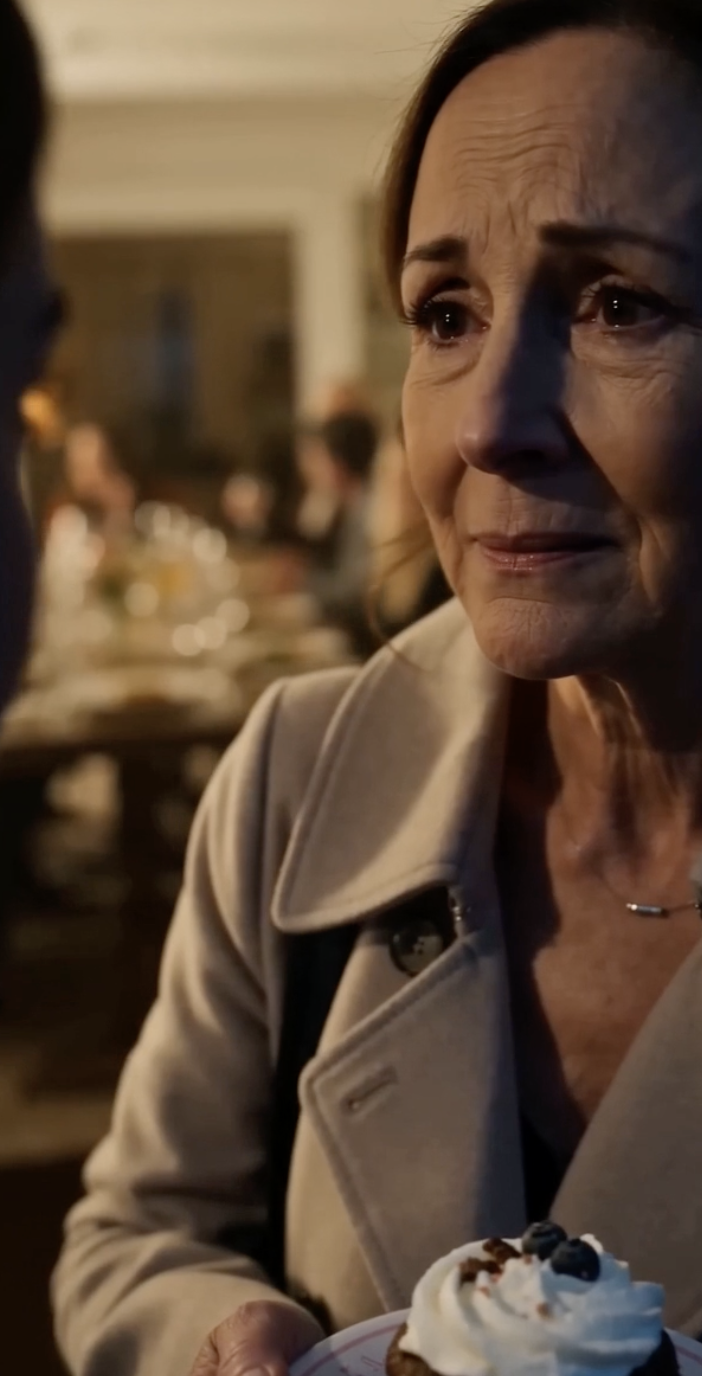
When my mother appeared at my front door carrying a single cupcake, I almost laughed.
Behind me, twelve people were sitting around the dining table. My husband’s parents were there, along with his sister, two cousins, and several friends. Candles burned between the wine glasses, the house smelled of roast chicken and rosemary, and everyone had spent the evening congratulating us.
That afternoon, my husband Daniel and I had finally signed the papers to buy the house.
For most people, it was just a beautiful home.
For me, it meant something much bigger.
I had grown up moving from one rented apartment to another with my mother, Margaret. After my father left when I was seven, money disappeared almost overnight. There were winters when my mother slept on the sofa so I could have the only bedroom. She worked at a pharmacy during the day and cleaned offices at night.
But as I grew older, something between us changed.
Margaret became proud, distant, and strangely uncomfortable whenever I tried to help her.
When Daniel and I began doing well, I offered to pay off her debts.
She refused.
I offered to find her a better apartment.
She refused that too.
Then, eight months before our housewarming dinner, we had our worst argument.
“You spent your whole life struggling for me,” I told her. “Why won’t you let me do something for you now?”
Her face hardened.
“I don’t need to be rescued by my daughter.”
We barely spoke after that.
I invited her to the dinner anyway.
She never replied.
So when I opened the door that evening and found her standing there in an old beige coat, holding one small chocolate cupcake on a plate, I didn’t know whether to hug her or ask why she had come.
“Mom?”
She smiled nervously.
“Happy birthday, Emily.”
I froze.
With everything surrounding the house, I had almost forgotten that it was also my thirty-fourth birthday.
“You remembered.”
“I always remember.”
Behind me, laughter drifted from the dining room.
My mother looked past my shoulder at the beautiful table, the flowers, the expensive glasses.
For a moment, I saw embarrassment cross her face.
“I won’t stay,” she said.
Something inside me sank.
“Then why did you come?”
She set the cupcake on the small table beside the entrance.
Then she reached into her handbag.
I expected a card.
Instead, she pulled out two old brass keys.
The moment I saw them, I felt confused.
“What are those?”
Her eyes filled with tears.
“The reason I never let you pay my debts.”
She placed the keys in my palm.
Twenty-six years earlier, after my father disappeared, my mother had not only lost her marriage.
She had almost lost the little house my grandparents had left her.
To keep food on the table, she had secretly sold it.
At least, that was what she had always told me.
Now she finally admitted the truth.
She had never sold it.
She had rented it out for more than two decades.
Every month, after paying taxes and repairs, she had placed the remaining money into an account in my name.
She never touched it.
Not when her car broke down.
Not when she needed dental work she couldn’t afford.
Not even during the winter when her heating was shut off for nearly a week.
I stared at her.
“Why?”
Her voice broke.
“Because I couldn’t give you the childhood I wanted to give you. So I decided I would give you something later.”
I looked down at the keys.
“How much is in the account?”
She told me.
I had to ask her to repeat the number.
It was enough to pay off nearly half of our new mortgage.
But then she said something that mattered far more.
“The old house is yours too.”
I shook my head immediately.
“No.”
“Emily—”
“No. I’m not taking your home.”
“It hasn’t been my home for twenty-six years.”
I looked at the woman standing before me.
Her coat was worn at the cuffs. Her handbag was old. She had spent years refusing every gift I tried to give her because she had been quietly saving something for me.
Suddenly, I understood why she had been so stubborn.
But I also understood something she had not.
I closed her fingers around the keys.
“Then we’re going to do this differently.”
That night, I brought my mother into the dining room.
There was an empty chair beside mine.
She tried to protest, but Daniel stood and pulled it out for her.
We cut her tiny cupcake into ridiculous little pieces so everyone could share it.
And for the first time in months, my mother laughed.
Two weeks later, Daniel and I made a decision.
We did not use the money to reduce our mortgage.
Instead, we renovated my grandparents’ old house.
When it was finished, I drove my mother there.
She cried before we even reached the front door.
The kitchen had been restored. The leaking roof was gone. Her mother’s old roses still grew beside the porch.
I handed her the same two brass keys.
“This is your home again.”
She stared at me.
“I gave this to you.”
“And I’m giving you something back.”
My mother moved into the house that spring.
Daniel and I kept the savings account untouched, exactly as she had maintained it for all those years. Later, when our daughter Sophie was born, we turned it into an education fund for her.
Margaret became the grandmother she had always dreamed of being.
Sunday dinners became a tradition. She never arrived with just one cupcake again. She brought entire cakes, usually far too large, and always complained when we tried to help clean the kitchen.
She lived in that little house for another sixteen years.
When she died peacefully at seventy-eight, I found the brass keys in the drawer beside her bed.
There was a note underneath them.
It contained only one sentence:
“Home was never the house, Emily. It was knowing you would always open the door for me.”
I still have those keys.
And every year on my birthday, I buy one small chocolate cupcake.
Not because it was the greatest gift my mother ever brought me.
But because that was the night I finally understood everything she had spent her life trying to give me.