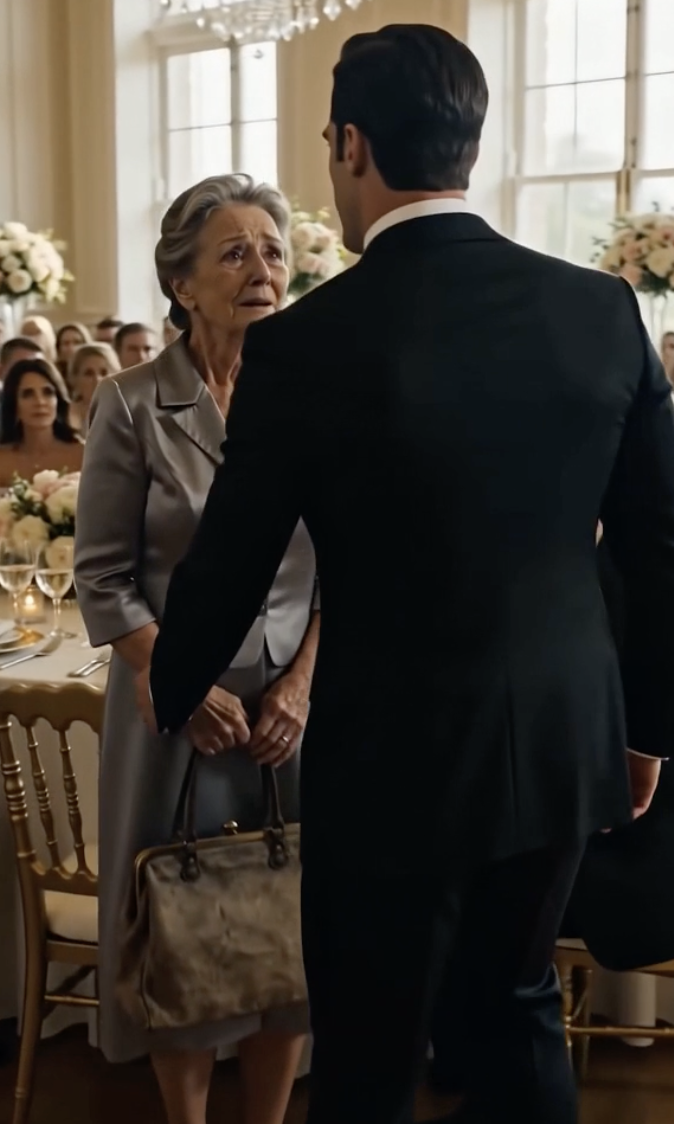
Emily had imagined her wedding day for years, but she had never imagined seeing her mother standing in the middle of the reception.
The music stopped. Conversations faded. Nearly two hundred guests turned toward the elderly woman in the gray dress who stood beside the tables, clutching an old handbag with both hands.
Emily froze.
She had not seen Margaret for twenty-three years.
When Emily was seven, her mother disappeared from her life. Her father, Richard, told her that Margaret had chosen another man and abandoned them. Every time Emily asked questions, he gave the same answer.
“She made her choice. We have to live with it.”
Emily eventually stopped asking.
Her father raised her alone. He attended school events, paid for university and was now sitting at the wedding table only a few meters away.
For years, Emily hated her mother.
She hated her most on birthdays.
She hated her when she graduated.
And that morning, while putting on her wedding dress, she had briefly wondered whether Margaret even knew her daughter was getting married.
Now Margaret was standing in front of her.
“Why are you here?” Emily whispered.
Margaret’s eyes filled with tears.
“I came because this might be my last chance to tell you the truth.”
Richard suddenly stood.
“She shouldn’t be here.”
Margaret looked at him.
“I think twenty-three years is long enough.”
Then she opened her handbag and removed a bundle of envelopes tied together with a faded ribbon.
Emily recognized her own name.
Every envelope was addressed to her.
There were dozens.
Margaret explained what had happened.
When Emily was seven, her parents’ marriage had collapsed. Richard discovered that Margaret planned to leave him and take Emily with her.
A bitter custody battle followed.
Richard’s family had money, influential lawyers and a large home. Margaret had recently lost her job and was struggling financially.
She lost custody.
But she had never disappeared voluntarily.
For years, Margaret wrote letters.
Birthday cards.
Christmas cards.
Letters explaining that she loved Emily.
Letters asking for photographs.
Letters containing phone numbers and addresses.
Richard had kept every one of them.
“You told me she never contacted us,” Emily said, staring at her father.
Richard’s face went pale.
“I was protecting you.”
“From what?”
“From being disappointed again.”
Margaret shook her head.
“You were protecting yourself.”
Then she handed Emily one final envelope.
It had been written when Emily was eighteen.
Inside was a short letter and a photograph of Margaret standing outside Emily’s high school on graduation day.
She had been there.
Richard had seen her and ordered security not to let her inside.
Emily slowly sat down.
Suddenly, twenty-three years of her life looked different.
Margaret had known about the wedding because Emily’s aunt had secretly contacted her several months earlier. She had spent weeks deciding whether to come.
“I didn’t want to destroy your wedding,” Margaret said. “I only wanted you to know that I never stopped loving you.”
Emily looked across the room at her father.
She loved him. He had raised her.
But loving someone did not erase what he had done.
“You stole my decision from me,” she told him quietly. “You decided who I was allowed to love.”
Richard began to apologize, but Emily asked him to leave the room.
Then she turned toward Margaret.
For a moment, neither woman moved.
Finally, Emily stepped forward.
“I can’t give you twenty-three years back.”
“I know.”
“And I can’t pretend I’m not angry.”
“I understand.”
Emily’s voice broke.
“But you can stay for the wedding.”
Margaret covered her mouth and began to cry.
Emily hugged her.
It was not the magical reunion people imagined in movies. There was too much pain for that.
But it was a beginning.
During the following year, mother and daughter met slowly. Coffee first. Then dinners. Then long conversations about everything they had lost.
Richard eventually admitted what he had done and began therapy. Emily did not immediately forgive him, but she allowed him to remain part of her life under one condition: no more lies.
Three years later, Emily and her husband welcomed their first daughter.
They named her Grace.
Margaret was in the hospital when she was born.
One photograph from that day now hangs in Emily’s home.
Three generations of women are together in it.
Margaret is holding baby Grace while Emily stands beside her, smiling through tears.
Emily cannot change the childhood she lost.
Margaret cannot recover the years someone took from her.
But neither of them wastes time wondering anymore.
Because after twenty-three years of silence, the truth finally gave them something neither thought they would ever have again:
time together.