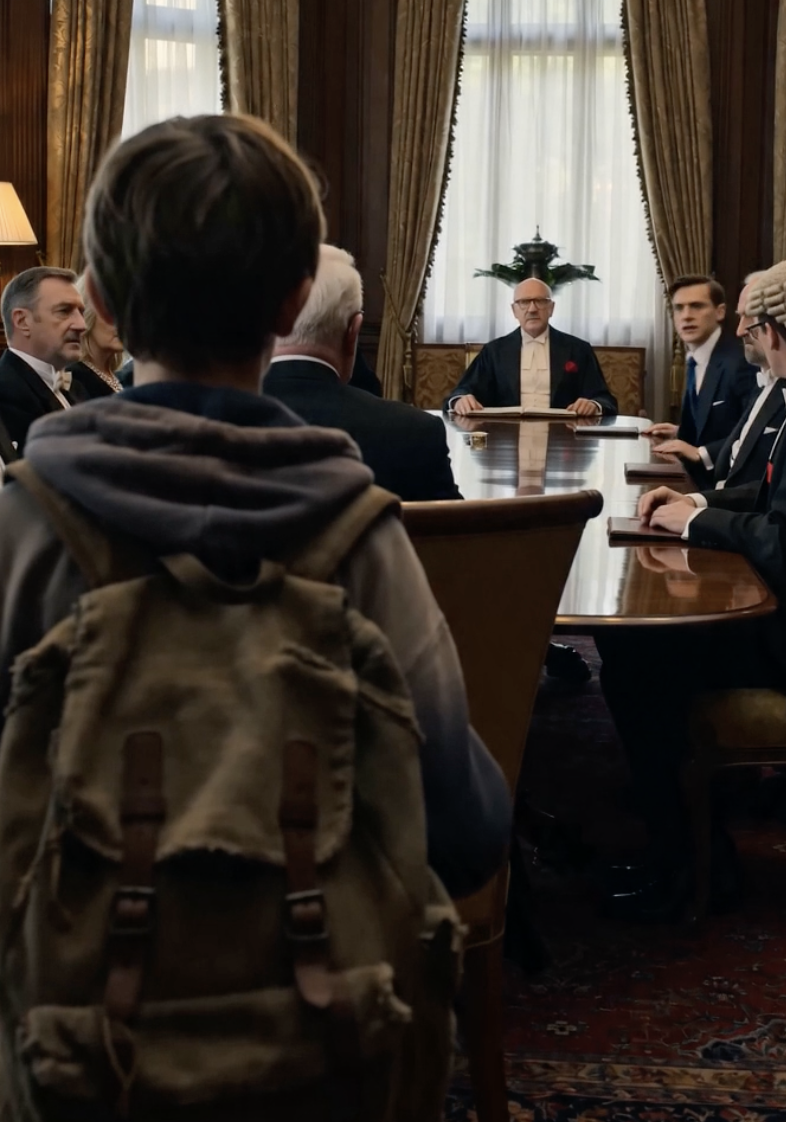
No one in the room expected a twelve-year-old boy to interrupt the reading of Sir William Harrington’s will.
The long oak table was surrounded by lawyers, relatives, and members of the Harrington family who had spent the morning speaking quietly about property, investments, and inheritance. At the far end sat William’s eldest son, Daniel, already behaving as though everything his father had owned now belonged to him.
Then the heavy door opened.
A thin boy stepped inside carrying an old backpack.
His clothes were clean but worn, and he looked completely out of place among the dark suits and polished shoes.
For several seconds, nobody spoke.
The boy looked around nervously before asking:
“Is this where they’re reading William Harrington’s will?”
Daniel frowned.
“Who are you?”
The boy swallowed.
“My name is Noah Bennett.”
That name changed everything.
Twenty years earlier, Daniel’s younger sister, Emily, had disappeared from the Harrington family after a terrible argument with her father. She had fallen in love with a young mechanic named Thomas Bennett, a man William considered unsuitable for his daughter.
William demanded that Emily choose between her family and Thomas.
Emily chose Thomas.
She left London, married him, and never returned.
The family told everyone that Emily had rejected them. William removed her photographs from the house and refused to speak her name.
But the truth was more complicated.
For years, Emily wrote to her father.
William read every letter.
He simply never answered.
Pride kept them apart until it was too late.
Thomas died when Noah was still a baby. Emily raised her son alone, working in a small bookshop and never asking the Harrington family for money.
She told Noah very little about his grandfather.
Only that he was a difficult man who had once loved her very much.
Then, when Noah was ten, Emily became seriously ill.
She died less than a year later.
Before her death, she gave Noah a sealed envelope.
“Keep this,” she told him. “If anything ever happens to your grandfather, take it to his lawyer.”
Noah had kept that promise.
Now he stood in the middle of the room and removed the worn envelope from his backpack.
The lawyer conducting the meeting, Mr. Collins, immediately recognized William’s handwriting on the outside.
He opened it carefully.
Inside was an old photograph of Emily as a child, several letters, and a handwritten statement signed by William Harrington.
The room became completely silent as Collins began to read.
William admitted that he had known about Noah for years.
Emily had sent him photographs of the boy after his birth.
At first, William had refused to respond.
But as he grew older, regret replaced anger.
He secretly began following his grandson’s life from a distance.
He knew where Noah went to school.
He knew Emily had struggled financially.
He even knew when Thomas died.
Yet William had remained silent because every year made returning more difficult.
Then, six months before his own death, William finally traveled to the town where Emily lived.
He arrived too late.
Emily was already gone.
A neighbor told him where she was buried.
William spent almost an entire afternoon sitting beside his daughter’s grave.
That evening, he changed his will.
Collins placed the letter on the table and unfolded the official document.
Daniel leaned forward.
According to the new will, the family estate would not pass entirely to him.
A large trust had been created for Noah.
His education would be paid for, and when he turned twenty-five, he would receive Emily’s share of the family estate.
But money was not the most important part.
William had also left Noah something personal.
A small wooden box was brought into the room.
Inside were every letter Emily had ever sent him.
None had been thrown away.
There were birthday cards, photographs of Noah learning to walk, drawings he had made as a child, and a final unopened letter Emily had written shortly before her death.
Noah stared at the box.
“So he knew about me?”
Collins nodded.
“Yes.”
“Then why didn’t he come?”
No one had an easy answer.
Finally, Daniel spoke.
For years, he had blamed Emily for destroying the family.
Now he understood that his father’s pride had done just as much damage.
“He should have,” Daniel said quietly. “He should have come to you. And to your mother.”
Noah did not cry until he found a photograph at the bottom of the box.
It showed Emily at seventeen, laughing beside her father.
On the back William had written:
“My greatest mistake was believing I had more time.”
That sentence stayed with Noah.
The inheritance did not magically turn strangers into a family.
For the first few months, Noah continued living with his mother’s closest friend, Sarah, who had raised him since Emily’s death.
Daniel began visiting.
At first their conversations were awkward.
Then Daniel brought old family albums.
He told Noah stories about Emily as a child: how she climbed trees in expensive dresses, how she hated piano lessons, and how she once rescued an injured dog and hid it in her bedroom for three days.
For the first time, Noah began discovering the part of his mother’s life she had rarely discussed.
Years passed.
The trust paid for his education, but Noah never became interested in the luxurious life some members of the Harrington family expected him to choose.
He studied law.
At twenty-seven, he became a solicitor specializing in family disputes and inheritance cases.
Daniel remained part of his life, eventually becoming the uncle Noah had never known he needed.
They could not repair what had happened between William and Emily.
They could only refuse to repeat it.
Many years later, Noah kept his grandfather’s wooden box in his own office.
Whenever angry parents or children sat across from him refusing to speak to one another, he remembered those unopened letters.
He had learned something from a grandfather he barely knew and a mother who had spent too many years waiting for an apology.
Money could be divided.
Property could be returned.
A will could be rewritten.
But lost years could never be inherited.
And that was why Noah spent the rest of his life making sure silence never became the most expensive thing a family left behind.