For thirty-two years, Margaret Hale kept an old train ticket inside the smallest pocket of her handbag.
The paper had faded to yellow. Its edges were torn, and the ink had almost disappeared. On the back, however, a few handwritten words were still visible:
“If one day you find yourself alone, use this ticket. I’ll be waiting.”
It had been written by her only son, Daniel.
Margaret had not seen him since he was twenty-four.
Their relationship had once been warm. After Margaret’s husband died unexpectedly, Daniel became the center of her entire world. She worked long hours in a small bakery in London so he could study and build the life she believed he deserved.
But as Daniel grew older, love slowly turned into control.
Margaret questioned every decision he made.
The job he accepted.
The city he wanted to move to.
And most of all, the woman he planned to marry.
During their final argument, Margaret said something she would regret for the rest of her life.
“If you leave with her, don’t expect to come back when everything goes wrong.”
Daniel stood silently by the front door.
Then he picked up his suitcase.
“I’m not leaving because I don’t love you, Mum,” he said. “I’m leaving because you won’t let me become my own person.”
He moved to York the following morning.
A few weeks later, an envelope arrived.
Inside was the train ticket and a short note.
Daniel had written that he did not want anger to become the last thing between them. He gave her his new address and asked her to visit whenever she was ready.
Margaret never went.
At first, she told herself she needed time.
Then weeks became months.
Months became years.
Pride made the first year easier.
Shame made every year after that harder.
Daniel continued sending Christmas cards for almost a decade. Margaret read every one, but she never replied.
Eventually, the cards stopped.
She later heard from an old family friend that Daniel had married and become a father.
That knowledge hurt more than she expected.
Somewhere in England, she had a grandchild who did not even know her name.
Still, she did nothing.
Then, at eighty-one, Margaret lost her younger sister, Ruth.
After the funeral, she returned to her silent flat and sat alone at the kitchen table.
There were no voices in the hallway.
No one called to ask whether she had arrived home safely.
For the first time, she understood the sentence Daniel had written three decades earlier.
“If one day you find yourself alone…”
The next morning, Margaret took the old ticket from her handbag and went to the station.
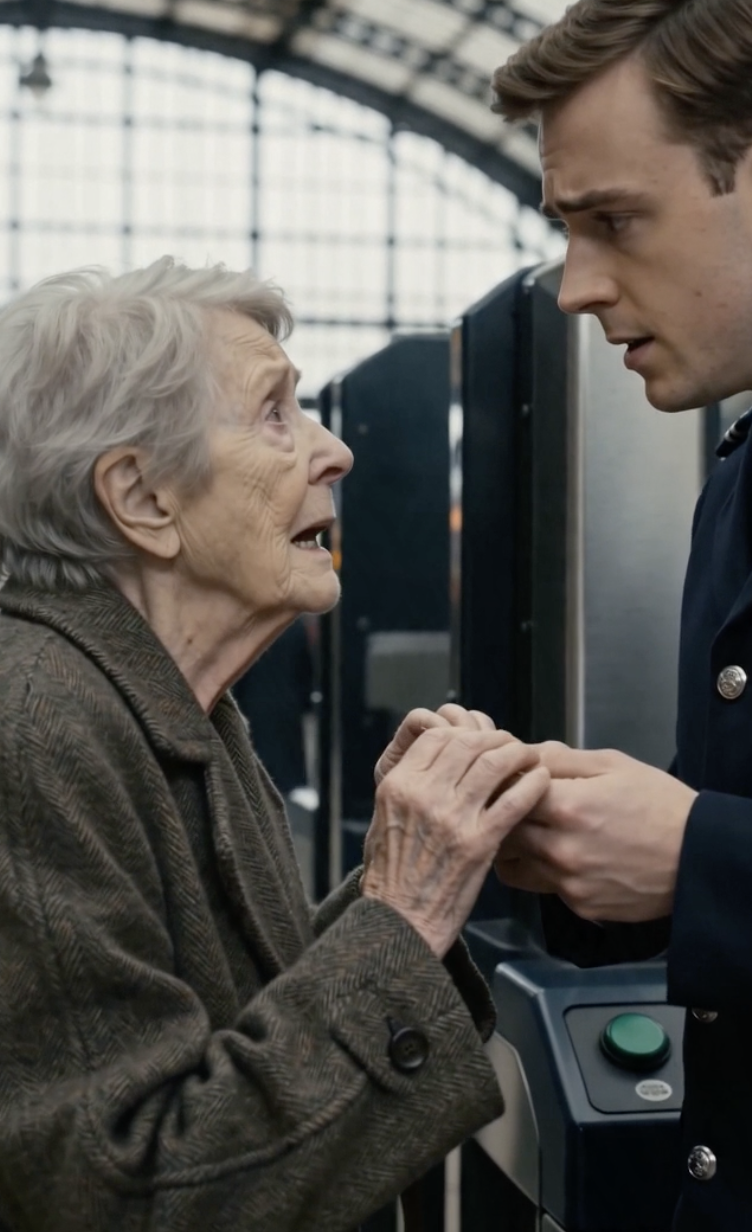
At the barrier, a young railway employee noticed the fragile piece of paper in her trembling hand.
“Ma’am, this ticket is very old,” he said gently.
Margaret gave a nervous smile.
“I know.”
He looked at the date and then at her.
“This can’t be used anymore.”
Her eyes filled with tears.
“I wasn’t really expecting it to.”
She turned the ticket over and showed him the message.
“I just need to get to York.”
Something in her voice made him stop.
Instead of sending her away, the young man walked with her to the ticket office, helped her buy a new ticket and found her a seat on the next train.
Before she boarded, he handed the old ticket back to her.
“Whatever is waiting at the other end,” he said, “I hope you’re not too late.”
Margaret held those words all the way to York.
Daniel’s old address no longer belonged to him, but a neighbor remembered the family and gave Margaret the name of the village where he now lived.
Two hours later, a taxi stopped outside a modest brick house.
Margaret almost told the driver to turn around.
Instead, she walked to the door.
A man in his late fifties opened it.
His hair had turned gray.
His face was older.
But Margaret recognized her son instantly.
Daniel stared at her as though the past had suddenly stepped onto his doorstep.
Neither of them spoke.
Finally, Margaret opened her handbag and held out the old train ticket.
“I’m sorry it took me thirty-two years.”
Daniel looked down at the paper.
His eyes filled with tears.
“I thought you threw it away.”
“Never.”
For several painful seconds, neither moved.
Then Daniel stepped forward and wrapped his arms around his mother.
Margaret began to sob against his shoulder.
She apologized for the years she had wasted.
Daniel admitted that he had eventually stopped writing because every unanswered letter felt like another rejection.
Neither pretended that one embrace could erase three decades.
But both agreed that they would not lose another day.
That evening, Margaret met Daniel’s wife, Anna.
Then she met her granddaughter, Sophie, a twenty-eight-year-old primary school teacher who had grown up believing her grandmother simply did not want to know them.
Margaret told her the truth.
Not an excuse.
The truth.
“I was proud, stubborn and afraid to admit I was wrong.”
Sophie reached across the table and took her hand.
“You’re here now.”
Over the next three years, Margaret divided her time between London and York.
She attended Sophie’s wedding.
She spent Christmas with Daniel for the first time in more than thirty years.
And when Margaret’s health began to fail, she did not return to her empty flat.
She moved into a small cottage near her son.
Daniel visited every morning.
Sophie came every Sunday with flowers and pastries.
Margaret died peacefully at eighty-five, with her son holding one hand and her granddaughter holding the other.
After the funeral, Daniel found the old railway ticket carefully framed beside his mother’s bed.
Underneath it, Margaret had written one final sentence:
“The journey I was most afraid to take became the one that brought me home.”
Daniel kept the frame.
Years later, it still hung in his hallway.
Not as a reminder of thirty-two lost years, but of something his family never forgot again:
sometimes pride can keep a door closed for decades, but as long as someone is still willing to knock, it may not be too late to open it.