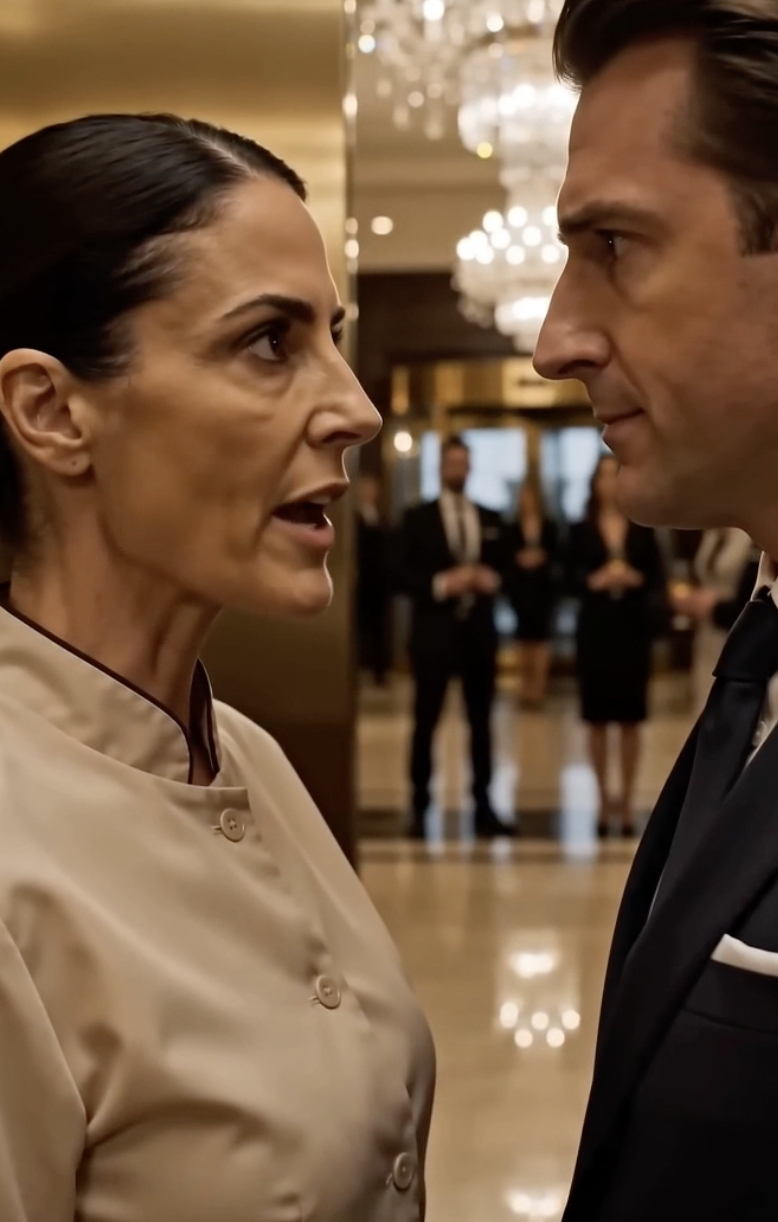
For eighteen years, Margaret Collins entered the Grand Ashford Hotel through the staff entrance before sunrise.
She polished brass rails, prepared private suites, remembered which guests needed extra pillows, and quietly corrected mistakes before anyone important noticed them.
Most people saw only the beige uniform.
Very few knew the life behind it.
Margaret had once studied accounting with plans of opening a small business with her husband, Daniel. But when Daniel died unexpectedly, she was left alone with a seven-year-old daughter and bills she could not postpone. She abandoned university, accepted a housekeeping job at the Ashford, and spent the next two decades making sure her daughter had opportunities she had lost.
She never regretted it.
Her daughter, Emily, eventually became a doctor in Manchester.
Margaret stayed at the hotel because the work had become part of her life.
Then Richard Hale became the new managing director.
Richard was polished, ambitious, and determined to transform the old family-owned hotel into something more profitable. Within three months, longtime employees were replaced, departments were cut, and anyone Richard considered “old-fashioned” became a target.
Margaret knew her turn would come.
She simply never expected it to happen in the middle of the hotel’s biggest charity reception.
That evening, hundreds of guests filled the marble lobby beneath enormous crystal chandeliers. Margaret had been asked to assist upstairs when she noticed an elderly guest struggling near the lifts.
She left her assigned station for less than five minutes to help him.
Richard saw her returning.
His expression hardened.
“Where have you been?”
Margaret explained.
Richard did not lower his voice.
“I didn’t ask you to abandon your post.”
Several guests turned toward them.
Margaret felt their eyes.
“The gentleman needed help.”
“We employ concierge staff for that.”
“He looked unwell.”
Richard stepped closer.
“This is exactly the problem. You do whatever you want because you’ve been here so long you think the rules no longer apply to you.”
Margaret stared at him.
After eighteen years of service, she had imagined that if she ever left the Ashford, she would walk out quietly after a retirement dinner.
Instead, she was being humiliated in front of strangers.
Richard continued.
“Go downstairs, collect your things and leave. Human Resources will contact you tomorrow.”
A silence spread through the lobby.
Margaret’s face went pale.
“Are you firing me?”
“Yes.”
She took a slow breath.
Then she said something that made Richard laugh.
“I don’t think you have the authority to do that.”
Richard shook his head.
“I run this hotel.”
Before Margaret could answer, a voice came from behind them.
“Actually, Mr. Hale, she’s right.”
Everyone turned.
A grey-haired man in a dark suit was crossing the lobby carrying a leather folder.
His name was Jonathan Reed, solicitor for the Ashford family.
Richard’s smile disappeared.
Jonathan opened the folder.
Inside were documents signed almost twenty years earlier by Edward Ashford, the hotel’s late owner.
Then the truth came out.
When Margaret had first joined the hotel, the Ashford had been close to bankruptcy.
One evening, while cleaning the former owner’s office, Margaret had noticed accounting papers scattered across his desk. Because of her unfinished accounting studies, she immediately saw something wrong.
A senior financial manager had been diverting money from the hotel for years.
Margaret could have ignored it.
Instead, she spent an entire night comparing invoices and bank records and brought the evidence to Edward Ashford the next morning.
Her discovery saved the company from losing millions.
Edward offered her money.
Margaret refused.
She asked for only one thing: job security until she chose to retire, provided she performed her duties honestly.
Edward insisted on making the agreement legally binding.
There was something else Richard did not know.
Before his death, Edward had transferred a small percentage of the hotel company into a trust in Margaret’s name as gratitude for saving the business.
It was not enough to make her wealthy.
But it gave her shareholder rights.
Including protection from dismissal without board approval.
Richard stared at the documents.
“You’re telling me a housekeeper owns part of this hotel?”
Margaret answered calmly.
“No. I’m telling you the woman you just called useless helped save it.”
The room became completely silent.
Jonathan then revealed why he had come to the reception.
The board had already received complaints about Richard’s treatment of longtime employees, questionable dismissals and unnecessary expenses.
His confrontation with Margaret became the final incident.
Richard was suspended that evening.
A week later, the board terminated his contract.
Margaret could have demanded his public humiliation.
She did not.
She returned to work the following Monday.
But something had changed.
For the first time, everyone knew her story.
Six months later, Margaret chose to retire on her own terms.
The hotel organized a dinner in the same lobby where Richard had tried to dismiss her.
Former employees returned to see her. Guests sent letters. Even Emily flew home early from the hospital to stand beside her mother.
Near the lifts, the hotel installed a small plaque:
“Character is revealed not by the position a person holds, but by what they choose to do when nobody is watching.”
Margaret spent her retirement near her daughter and later became a grandmother.
She never became famous.
She never wanted to.
But once a year, she returned to the Grand Ashford for afternoon tea.
And whenever a new employee asked why an elderly woman in an ordinary coat was always greeted personally by the hotel director, someone would point toward the plaque.
Because Margaret Collins had spent eighteen years being treated as though she were invisible.
In the end, everyone learned that the quietest person in the building had once been one of the reasons the doors were still open.