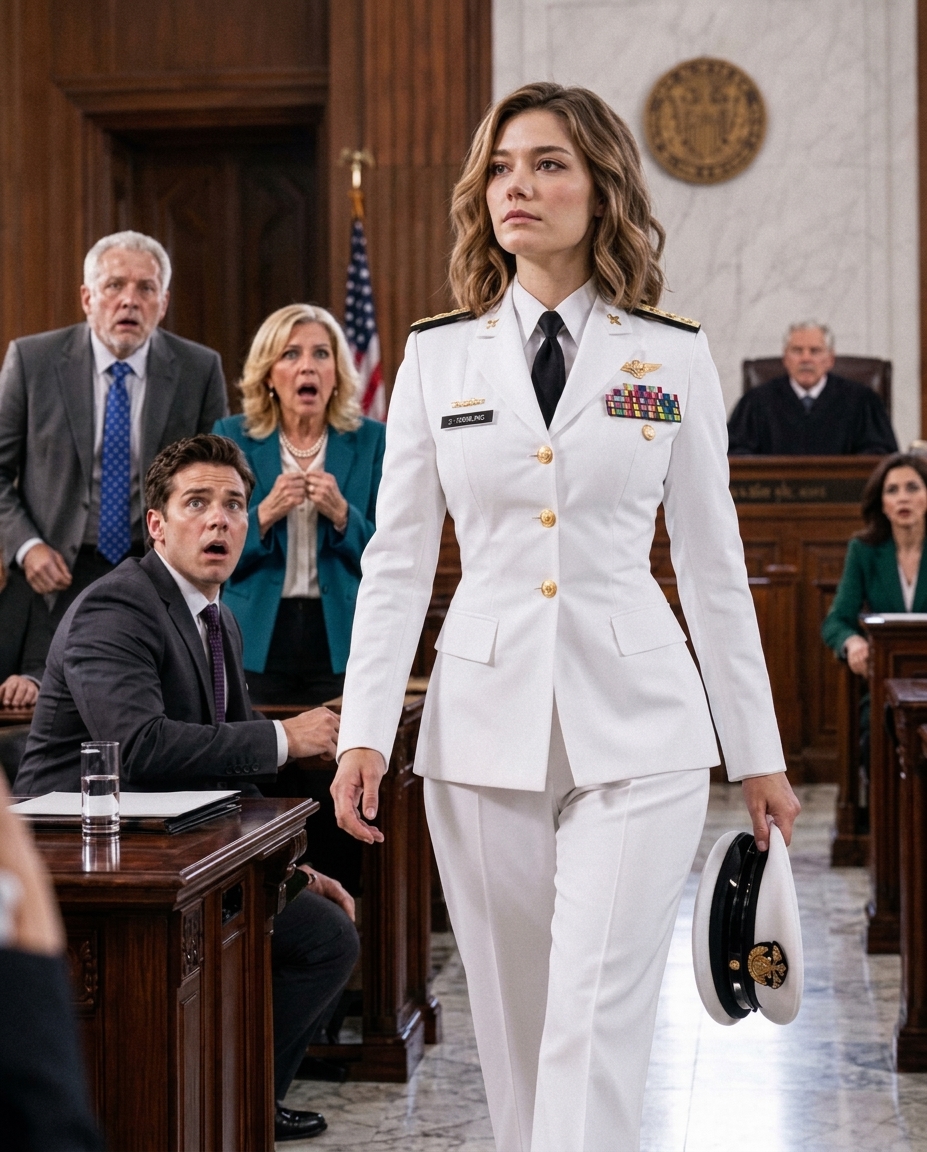
My parents entered federal court believing they were there to save their son.
Then the courtroom doors opened, and my white ceremonial uniform caught the light.
My brother Luke turned around.
“No… this can’t be happening.”
For twelve years, he had told everyone I had failed in the Navy.
Now I was about to testify against him.
Luke sat at the defense table in a tailored navy suit. Behind him were our parents, Bernard and Celina Sterling.
My mother dropped her purse.
My father rose halfway to his feet.
The prosecutor motioned toward the witness stand.
“Please state your name and position for the record.”
I sat down.
“Commander Claire Sterling, United States Navy. Currently assigned to an interagency federal contracting oversight team.”
Luke closed his eyes.
It was over.
Not the trial.
His version of me.
I had been nineteen when I told my father I wanted to enlist.
“Don’t start something you can’t finish,” he had warned me.
But I finished everything I started.
Training. College. Deployments. Promotions.
My family simply never knew.
Luke had made sure of that.
He forged emails from an old account, created documents that appeared to show a disgraceful separation from service, and told our parents I had disappeared because I was ashamed.
When I came home and tried to tell them the truth, Dad chose the forged papers.
Mom asked whether I had returned because I needed money.
That was the night I stopped begging my own family to believe me.
Years later, during a federal review of storm-recovery spending, a familiar company crossed my desk.
Vance Shield Recovery.
Luke’s company.
I opened the file.
And found my own life inside it.
My military record.
Parts of my service information.
My copied signature.
Even details from my personal history had been rewritten into a hardship narrative used to support contract applications.
Luke’s cruelty had an almost perfect symmetry.
At home, he told everyone I had disgraced the Navy.
To the federal government, he used my legitimate service to make money.
His company claimed eligibility based on veteran-linked ownership and credentials tied to C. Sterling.
Me.
Except I owned nothing.
I had signed nothing.
Investigators began pulling records.
What started with one fraudulent certification expanded quickly.
Inflated invoices.
Related companies.
Manipulated contracts.
Millions moving through accounts Luke controlled.
Then investigators found my parents’ signatures.
Dad had guaranteed loans.
Mom had approved access to retirement funds.
They believed they were helping Luke protect the family business.
They had simply never asked enough questions.
At trial, the prosecutor placed a document in front of me.
“Is this your signature?”
“No.”
He produced another.
“Did you ever authorize your brother to use your military record to obtain federal contracts?”
“Never.”
“Do you own, or have you ever owned, fifty-one percent of Vance Shield Recovery?”
“No.”
A murmur moved through the courtroom.
Luke stared at the table.
His attorney stood for cross-examination.
He tried to make me sound bitter.
“You have been estranged from your family for years, correct?”
“Yes.”
“And you resent your brother?”
I looked at Luke.
“Being hurt by what someone did to you does not make a forged signature authentic.”
His attorney changed direction.
During the recess, my father found me in the hallway.
He looked ten years older.
“Claire.”
I kept walking.
“Please.”
I stopped.
“We didn’t know,” he said.
“You could have.”
“Luke showed us documents.”
“And I showed you me.”
He had no answer.
Mom appeared a moment later, already crying.
“Why didn’t you tell us how far you had gone in your career?”
I almost laughed.
“I did. You preferred the version where Luke was right.”
The verdict came after six days of testimony.
Luke was convicted on multiple counts involving fraud, false statements, and unlawful use of identifying information.
When the judge read the verdict, my brother did not look at me.
He looked at our parents.
Maybe that was the moment he finally understood they could not rescue him.
Bernard and Celina faced different consequences.
Investigators ultimately concluded that they had signed documents without fully understanding Luke’s scheme, though their blind loyalty still cost them dearly.
They sold family property.
Much of the retirement money they had trusted Luke with was gone.
But money was not what my father seemed to struggle with most.
It was the truth.
Months later, a letter arrived from him.
It said:
“I told you not to start something you couldn’t finish. I never noticed that you were the one child who always did.”
I read that line twice.
It did not erase twelve years.
But at least it was not an excuse.
My mother called several weeks later.
For once, she did not ask whether I needed money.
She asked:
“Can I get to know you again?”
I did not promise forgiveness.
I simply said:
“You can try.”
A year later, I returned to the same city for a formal ceremony.
My father was in the audience.
When I entered in uniform, he stood.
He said nothing.
He did not need to.
For years, my family had believed Luke was the son protecting the Sterling name and I was the daughter who had disgraced it.
In the end, the truth was almost exactly the opposite.
But seeing my brother convicted was not my real victory.
Neither was hearing my father admit that he had been wrong.
My victory was realizing I no longer needed my family to believe in my life for that life to be real.
Luke had spent years trying to erase my name.
In the end, hearing that same name spoken clearly in federal court was what brought every one of his lies down.