For twelve years, Edward Whitmore had kept the same unopened room at the end of the second-floor corridor.
No servant was allowed to enter it. No guest knew why the door remained locked. Even Edward himself rarely walked past it.
It had belonged to his younger sister, Margaret.
They had once been inseparable. Their mother died when Margaret was eleven, and Edward, already twenty-three, became more parent than brother. He paid for her education, frightened away unsuitable boyfriends, and convinced himself that protecting her gave him the right to decide what was best for her.
That belief destroyed them.
At twenty-one, Margaret fell in love with Samuel Carter, a schoolteacher with no money and no important family name. Edward called him an opportunist. Margaret called Edward cruel.
Their final argument lasted less than ten minutes.
“If you walk out with him,” Edward said, “do not come back expecting me to repair your mistakes.”
Margaret stared at him with tears in her eyes.
“You were supposed to be my brother, not my owner.”
Then she left.
Edward expected an apology within a month.
A month became a year.
A year became ten.
His pride slowly turned into regret, but by then he no longer knew where Margaret lived. Several letters he sent were returned. Samuel had changed jobs, and the couple seemed to have disappeared from the social circles Edward knew.
He told everyone he no longer cared.
That was a lie.
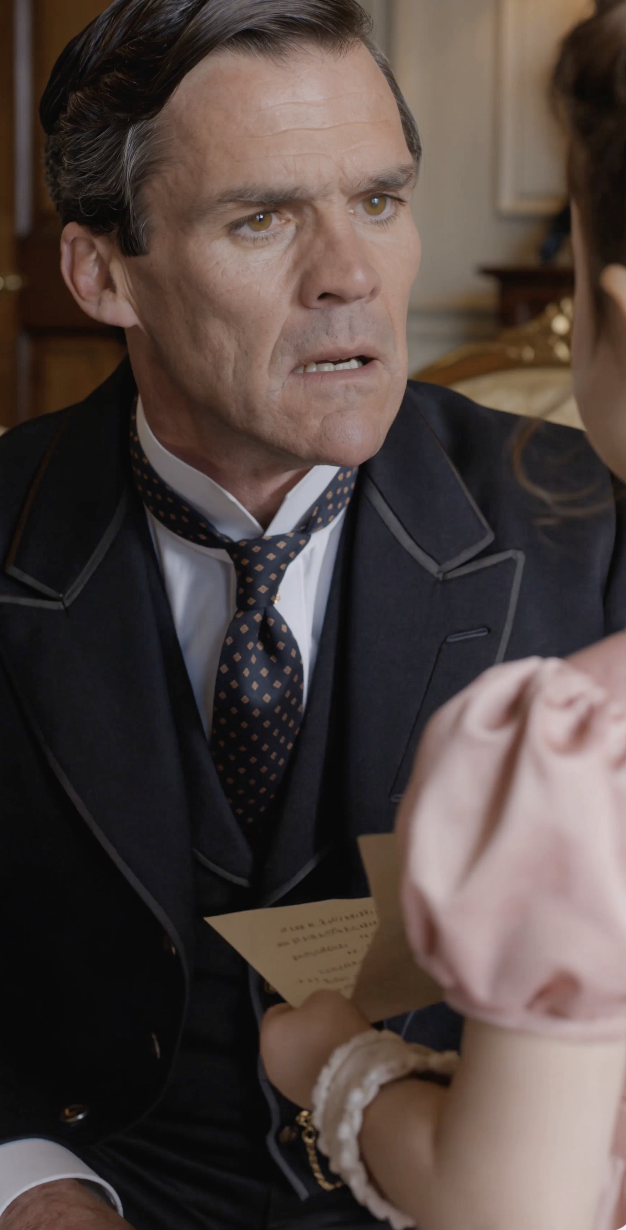
Then, on a quiet afternoon, a little girl in a pale pink dress appeared in his drawing room.
She could not have been older than eight.
One of the housemaids had found her standing outside the gates alone, holding a folded envelope so tightly that the paper had become damp in her hands.
Edward looked at the child impatiently.
“Who brought you here?”
“No one.”
“Where are your parents?”
The girl swallowed.
“My mother told me to come.”
Something in her voice made him stop.
She stepped forward and held out the envelope.
On the front was written:
For Edward. Please read this before you send her away.
Edward recognized the handwriting immediately.
His face changed.
“Where did you get this?”
“My mother wrote it.”
His fingers trembled as he took the letter.
“What is your mother’s name?”
The girl hesitated, as though she had rehearsed the answer many times.
“Margaret Carter.”
Edward sat down.
For several seconds, he could hear nothing except the ticking of the clock behind him.
He looked at the child again.
The shape of her eyes.
The small crease beside her mouth when she was nervous.
Margaret had looked exactly the same at that age.
“What is your name?”
“Rose.”
Edward unfolded the letter.
Margaret had written it six weeks earlier.
She told him that Samuel had died two years before from pneumonia. After his death, she had worked as a seamstress and raised Rose alone. Then came the diagnosis: an aggressive illness that had already spread too far for treatment to save her.
She had spent her final months trying to decide what would happen to her daughter.
There were relatives on Samuel’s side, but none able to care for a child permanently.
At last, Margaret had written to the brother she had not seen in twelve years.
There was no accusation in the letter.
That made it worse.
She wrote about childhood summers, about Edward carrying her home after she fell from a horse, about the night after their mother died when he sat beside her bed until sunrise because she was afraid to sleep alone.
Then came the final lines.
I spent years being angry with you. Later I understood that anger had become the last thing connecting us. I should have written sooner. So should you. We were both too proud, and time punished us for it.
Edward stopped reading.
Rose was watching him.
He forced himself to continue.
I am not asking you to replace me. No one can. I am asking you to give Rose something I can no longer give her: a home where she knows she is wanted.
His vision blurred.
At the bottom, Margaret had added one last sentence.
If there is any part of the brother I loved still inside you, please do not make her pay for the years we wasted.
Edward lowered the letter.
“When did your mother give you this?”
“She didn’t.”
His eyes lifted.
“A nurse did.”
Rose’s lower lip trembled.
“Mummy died nine days ago.”
Edward stared at her.
All those years he had imagined meeting Margaret again.
Sometimes she would apologize.
Sometimes he would.
Sometimes they would argue first and laugh later.
Never once had he imagined being too late.
He stood so suddenly that Rose stepped backward.
Edward looked toward the window, then toward the door, as if there might still be somewhere he could go to change what had happened.
There wasn’t.
“Why didn’t anyone tell me?”
Rose flinched at the sharpness in his voice.
Edward saw it immediately.
And for the first time, he understood that his anger had nowhere useful to go.
He knelt in front of her.
“I’m sorry,” he said quietly. “That wasn’t meant for you.”
Rose stared at him.
“Are you my uncle?”
“Yes.”
“Mummy said you might not want me.”
That sentence broke whatever pride Edward had left.
He covered his mouth for a moment.
Then he answered carefully.
“Your mother was wrong about one thing.”
Rose waited.
“You are not someone I have to decide whether to want. You are already my family.”
Her eyes filled with tears.
“Do I have to leave tomorrow?”
“No.”
“Next week?”
“No.”
“What if I’m difficult?”
For the first time that afternoon, Edward almost smiled.
“Your mother was extremely difficult.”
Rose looked shocked.
Then Edward added:
“And I loved her more than anyone in the world.”
The little girl began to cry.
He opened his arms but did not pull her toward him.
Rose made the choice herself.
She stepped forward.
Edward held his sister’s daughter while the old clock continued ticking behind them, measuring seconds he finally understood were not guaranteed to anyone.
The following morning, he unlocked Margaret’s room.
He did not turn it into a shrine.
Instead, he let Rose choose the curtains.
She filled the shelves with books, left dolls on the carpet, and complained that the room smelled “too much like old people.”
Within weeks, laughter returned to a house that had been silent for years.
Edward became Rose’s legal guardian.
He was not immediately good at raising a child. He bought ridiculous amounts of clothing because he did not know what girls needed. He tried to solve sadness with presents. He once sent a carriage to collect her from school after a light rain and embarrassed her so badly that she refused to speak to him through dinner.
But he learned.
More importantly, he learned to listen.
Years later, Rose discovered that Edward had kept Margaret’s letter.
She also discovered a box containing dozens of letters Edward had written to her mother over the years but never sent.
Rose did not judge him.
She simply asked:
“Why didn’t you mail them?”
Edward looked at the box for a long time.
“Because I kept thinking there would be a better day.”
Rose took his hand.
“And was there?”
“No.”
Edward lived long enough to see Rose finish university, marry a gentle young doctor, and have a daughter of her own.
She named the baby Margaret.
When Edward died peacefully at eighty-four, Rose was beside him.
His last request was simple.
“Don’t keep the room locked after I’m gone.”
Rose understood exactly what he meant.
She later transformed the Whitmore house into a home for children who had lost their parents and had nowhere permanent to go.
Above the entrance, she placed no family crest and no grand quotation.
Only a small brass plaque:
NO CHILD WHO ENTERS HERE WILL EVER BE TOLD THEY CAME TOO LATE.
Margaret and Edward never received the reunion both of them secretly wanted.
That part of their story could not be repaired.
But their mistake did not become Rose’s inheritance.
The little girl who had once entered a silent mansion carrying one folded letter grew up knowing exactly where she belonged.
And Edward spent the rest of his life making certain that the last door his sister ever asked him to open stayed open long after both of them were gone.