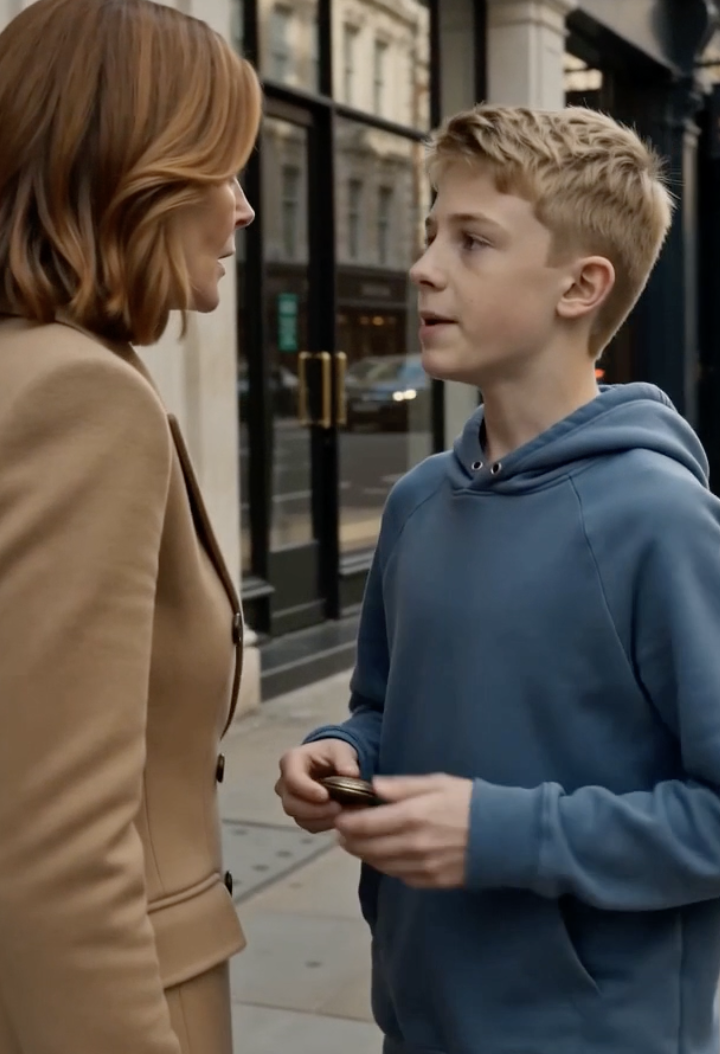
Claire Bennett was halfway through the revolving doors of the Mayfair Hotel when a teenage boy called after her.
“Excuse me… are you Claire?”
She stopped.
At forty-one, Claire had become used to people recognizing her from business events and charity photographs. She ran a successful interior design company in London, wore carefully tailored coats, and had spent years building a life that looked calm from the outside.
But the boy standing on the pavement clearly had no idea who she was.
He looked about fifteen. Blue hoodie, worn trainers, nervous hands.
“My name is Noah,” he said. “I think I have something that belongs to your family.”
Claire almost walked away.
Then he pulled an old bronze locket from his pocket.
Her breath caught.
Inside were two tiny black-and-white photographs: a young woman with dark hair and a little boy standing beside her.
Claire knew those faces.
The woman was her mother, Margaret.
The boy was Claire’s older brother, Daniel.
A brother who had disappeared thirty-three years earlier.
Claire had been only eight when her family fell apart.
Daniel was twelve.
Their father had died suddenly, leaving Margaret with debts she had hidden from everyone. She worked two jobs and struggled to keep their small flat. Daniel, angry and frightened, began skipping school and disappearing for hours at a time.
Then one winter evening, after a fierce argument with his mother, he left the house.
He never came home.
Police searched for months.
Margaret spent years following every possible lead. She placed advertisements, called shelters, contacted charities, and kept Daniel’s bedroom untouched.
Nothing.
Eventually the police told them Daniel had probably started a new life under another name—or that something worse had happened.
Margaret never accepted either explanation.
Before she died five years earlier, she gave Claire the matching half of the locket.
“If you ever find him,” she whispered, “tell him I never stopped waiting.”
Now Claire stared at the same object in Noah’s hand.
“Where did you get this?”
The boy swallowed.
“My dad gave it to me.”
Claire felt dizzy.
“What is your father’s name?”
“Daniel Reed.”
Reed had been Margaret’s maiden name.
Claire covered her mouth.
Noah explained that his father was alive, but seriously ill in a hospital outside London.
Daniel had spent most of his adult life refusing to speak about his childhood. Only recently, believing he might not have much time left, had he finally told Noah the truth.
The night he disappeared, Daniel had taken a train without knowing where he was going.
At a station, a man saw him sleeping alone and contacted a youth charity. Daniel was terrified that the police would send him home.
He gave a false surname.
Days became weeks.
By the time guilt replaced anger, Daniel learned that his mother had moved after losing the flat.
He tried once to find them.
He failed.
Then shame took over.
Every year, returning became harder.
He convinced himself that his mother and little sister hated him.
Claire’s eyes filled with tears.
“We looked for him for years.”
Noah nodded.
“That’s why I came. Dad found your company online two weeks ago, but he was too afraid to contact you.”
Claire did not attend the hotel meeting that afternoon.
Instead, she followed Noah to the hospital.
Daniel looked smaller than she remembered, his hair gray at the temples, his face tired.
But the moment he saw Claire, he began crying.
“Little Claire?”
She had imagined this meeting thousands of times.
In some versions she screamed at him.
In others she walked away.
Instead, she crossed the room and placed the matching half of the locket in his hand.
“Mum kept this until the day she died.”
Daniel closed his eyes.
“I thought she hated me.”
“No,” Claire said. “She was angry. She was broken. But she never stopped loving you.”
For several minutes neither of them spoke.
Then Daniel told her everything.
He had eventually been taken in by a foster family. He became a carpenter, married, and raised Noah alone after his wife died.
He had not built a glamorous life.
But he had built a good one.
His illness, doctors later explained, was treatable. The following months were difficult, but Daniel recovered.
Claire never pretended that thirty-three lost years could simply disappear.
There were painful conversations.
Questions without satisfying answers.
Moments when she resented him for staying away.
Moments when Daniel could barely forgive himself.
But they continued meeting.
Noah began calling Claire “Aunt Claire.”
Daniel visited their mother’s grave for the first time the following spring.
He placed the old locket beside the headstone and whispered:
“I’m sorry I took so long to come home.”
Claire stood beside him.
“You came back,” she said. “That has to count for something.”
Two years later, Daniel moved closer to Claire and opened a small woodworking shop with Noah.
Claire designed the interior.
Above the entrance hung one photograph: Margaret with her two children, taken shortly before everything went wrong.
For most of Claire’s life, that picture had represented the last moment her family had been whole.
Now it meant something different.
It was proof that a family could be broken for decades and still find a way to begin again.