Eighteen years earlier, she had lost her only daughter, Hannah.
Not to illness or an accident, but to pride.
After Margaret’s husband died, she became frightened of losing the last person she had left. That fear slowly turned into control. She questioned Hannah’s decisions, disliked the young man she planned to marry, and finally told her that if she walked out of the house with him, she should not expect to come back.
Hannah left.
Margaret expected her to return within days.
She never did.
Letters were sent and returned. Phone numbers changed. Years passed. Margaret later learned that Hannah had moved to another city, but by then every attempt to find her led nowhere.
The words from their final argument followed Margaret into old age.
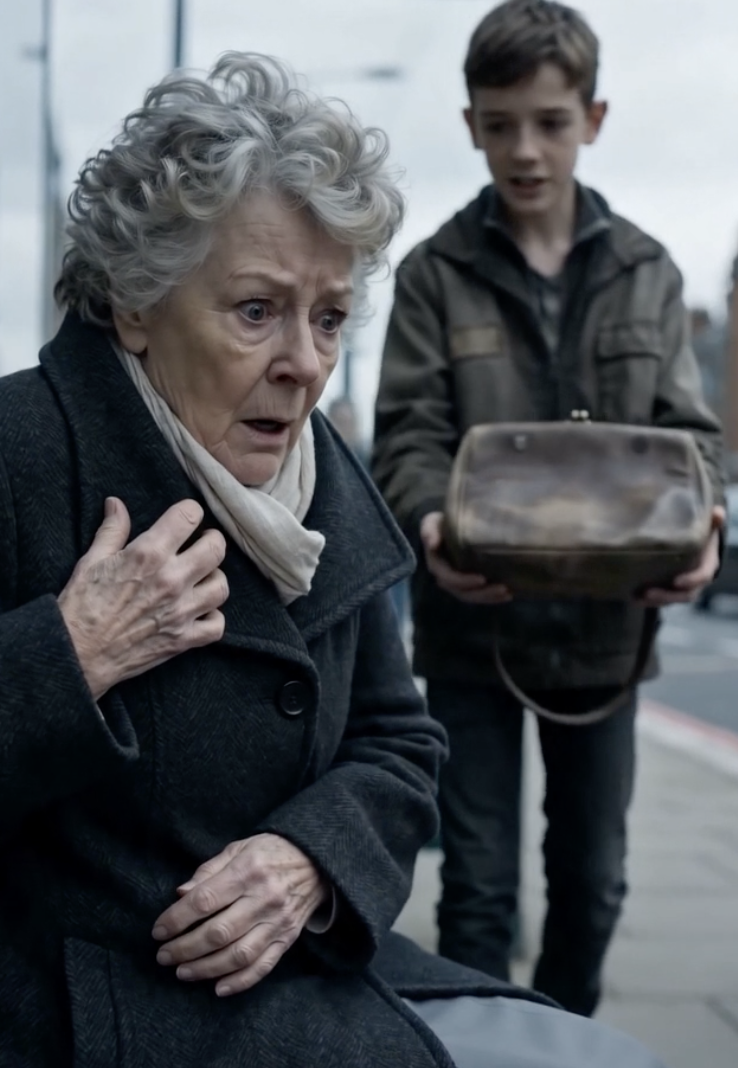
That rainy Tuesday afternoon, she was sitting alone at a crowded city bus stop when she suddenly reached beside her and froze.
Her handbag was gone.
Inside it were her bank cards, house keys, medication, nearly two hundred pounds in cash and the only photograph she still carried of Hannah as a teenager.
Margaret’s chest tightened.
She looked under the bench.
Nothing.
Then she saw a thin boy of about twelve approaching through the crowd.
He was wearing an old brown jacket and carrying her handbag in both hands.
—Ma’am? Is this yours?
Margaret stared at him.
—Where did you get that?
—It was near the ticket machine. A man kicked it by accident, so I picked it up.
Margaret grabbed the bag and immediately opened it.
The money was still there.
So were her cards and keys.
Everything was untouched.
She looked suspiciously at the boy.
—You didn’t take anything?
His expression changed.
—No.
Margaret instantly regretted the question.
The boy’s clothes were worn, but his eyes were honest.
She took out a twenty-pound note.
—Here. For bringing it back.
He shook his head.
—My mum says you don’t get paid for returning something that isn’t yours.
Margaret almost smiled.
—Your mother raised you well.
—She tries.
The boy helped her close the handbag, but Margaret’s trembling fingers caught on the lining.
A small photograph slipped out.
It fluttered onto the pavement.
The boy bent down first.
Then he stopped.
His smile disappeared.
He stared at the picture.
—Why do you have this?
Margaret felt suddenly cold.
—Because that’s my daughter.
The boy looked from the photograph to Margaret.
—That’s my mum.
For several seconds, Margaret could hear nothing except buses moving along the wet street.
—What did you say?
The boy pointed at the teenage girl in the photograph.
—Her name is Hannah Ellis. Well… Hannah Carter now.
Margaret gripped the bench.
—What’s your name?
—Noah Carter.
Margaret’s eyes filled with tears.
The boy standing in front of her was her grandson.
Hannah had never told him much about his grandmother. She had only said they had stopped speaking long before he was born.
Noah had been sent to buy medicine from the pharmacy while his mother waited at a nearby clinic.
Margaret was terrified to ask the next question.
—Is she here?
Ten minutes later, Hannah walked toward the bus stop.
She was forty-three now.
Margaret would have recognized her anywhere.
Hannah stopped when she saw her mother.
Neither woman spoke.
Then Margaret said the words she should have said eighteen years earlier.
—I was wrong.
Hannah began to cry.
Margaret did not make excuses. She told her daughter that fear had made her cruel, that pride had stolen almost two decades from them, and that she had regretted that final argument every day.
Hannah listened.
Then she quietly said:
—I wanted to call you so many times.
Their first embrace was awkward.
The second was not.
Rebuilding their relationship took time. They did not pretend eighteen years could disappear in one afternoon.
Margaret met Hannah’s husband, Daniel, and discovered she had another granddaughter, eight-year-old Sophie. Sunday lunches slowly became a family tradition. Hannah started visiting twice a week, and Noah often stopped by after school.
Two years later, Margaret moved into a small flat only ten minutes from her daughter’s home.
The old photograph from the handbag was placed in a frame on her mantelpiece.
Beside it stood a newer picture.
Margaret in the middle, Hannah beside her, Noah and Sophie laughing in front of them.
Whenever someone asked Noah how he had finally met his grandmother, he always gave the same answer.
—I found her handbag.
Margaret would smile and correct him.
—No, darling. You found something much more important.
Because that afternoon, a twelve-year-old boy had returned a bag containing money, keys and an old photograph.
But without knowing it, he had also returned a mother to her daughter—and given an entire family the years they still had left to love one another.