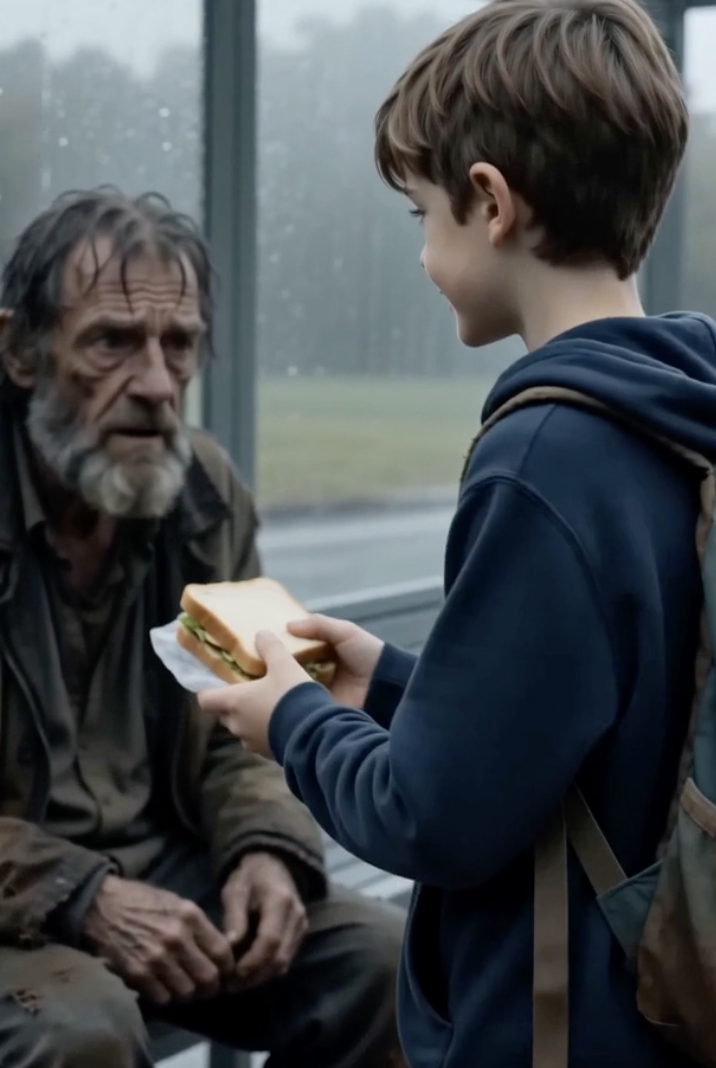
Rain had been falling since early morning when eleven-year-old Noah Carter noticed the old man sitting alone inside the bus shelter.
Everyone else hurried past him.
The man’s clothes were soaked, his shoes were torn, and his hands trembled from the cold. Noah was already several steps away when he stopped.
He looked at the lunch his mother had packed for school.
Then he turned around.
— Are you hungry?
The stranger slowly raised his head.
His name was Thomas.
Years earlier, Thomas had been a completely different man. He had a wife, a young daughter named Rachel, and a modest house filled with photographs and laughter.
Then his wife died suddenly.
Thomas collapsed under the grief.
He stopped working, isolated himself and eventually lost his home. Rachel, only eight at the time, went to live with her aunt.
Thomas convinced himself that his daughter would have a better life without him.
He disappeared.
It was the greatest mistake of his life.
For years he tried to rebuild himself, but shame always stopped him from searching for Rachel. By the time he finally found the courage, she had moved away and started a life of her own.
Thomas never knew where.
Now, decades later, he was sitting at a rainy bus stop when a boy he had never met held out a sandwich.
— You can have mine.
Thomas stared at him.
— What will you eat?
Noah shrugged.
— I’ll be home later. You look like you need it more.
Thomas accepted the sandwich with shaking hands.
Then he noticed something around Noah’s neck.
A small silver medallion.
His face changed instantly.
— Where did you get that?
Noah instinctively touched it.
— My mom gave it to me.
Thomas leaned closer.
There was a tiny scratch across the edge and a small letter “R” engraved on the back.
Thomas knew that medallion.
He had bought it for Rachel on her seventh birthday.
— What’s your mother’s name?
Noah hesitated.
— Rachel.
Thomas stopped breathing for a moment.
Before he could say another word, a woman came running through the rain.
— Noah!
She had been searching for her son after his school bus was delayed.
Then she saw the old man.
She froze.
Thomas slowly stood.
Neither of them spoke.
Twenty-seven years had passed, but Rachel recognized her father immediately.
— Dad?
Thomas began crying.
— I’m sorry.
Rachel stared at him with tears running down her face.
For years she had believed her father had simply chosen to abandon her.
Thomas told her the truth.
He explained how grief had destroyed him, how ashamed he had been, and how every year that passed made returning seem more impossible.
Rachel listened.
She did not forgive him instantly.
Too much time had been lost for that.
But she also did not walk away.
That afternoon, instead of leaving Thomas at the bus shelter, Rachel took him to a nearby café.
They talked for almost three hours.
Noah sat quietly beside them, slowly realizing that the hungry stranger to whom he had given his lunch was his grandfather.
The weeks that followed were not easy.
Rachel helped Thomas contact a local support organization, and he eventually moved into temporary housing. Later, he found a small permanent apartment and began working part-time repairing furniture, the trade he had practiced when Rachel was a child.
Father and daughter rebuilt their relationship slowly.
There were difficult conversations.
There was anger.
There were apologies.
But there were also birthdays, Sunday lunches and the first family photographs Thomas had taken in almost thirty years.
Two years later, Noah gave his grandfather a framed photograph.
It showed the three of them standing together.
Thomas placed it beside his bed.
The silver medallion remained around Noah’s neck.
Not because it was valuable.
But because one rainy afternoon, that tiny piece of metal connected three generations of a family that had believed they had lost each other forever.
And whenever Rachel remembered that day, one detail stayed with her most.
Her father had not been found by detectives, records or years of searching.
He had been found because an eleven-year-old boy saw a lonely man in the rain…
and decided not to walk past him.