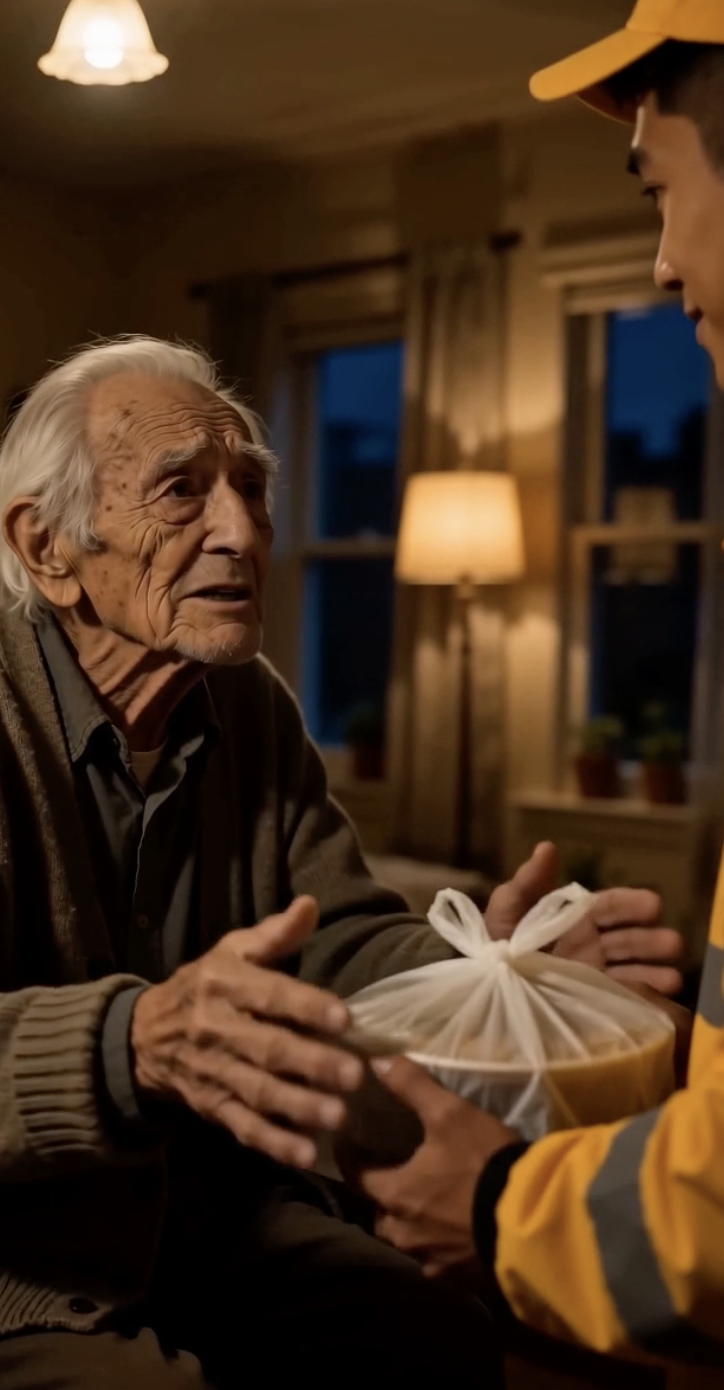
Ethan had delivered meals to hundreds of strangers, but Mr. Harris was the only customer who always asked him to stay for a cup of tea.
The old man lived alone in a small apartment filled with faded photographs, worn furniture, and the quiet loneliness of someone who had spent too many years waiting.
At first, Ethan always refused.
He had deliveries to finish, bills to pay, and no time to sit with strangers.
Then one cold evening he noticed Mr. Harris’s hands trembling as he tried to open his food container.
Ethan sat down.
That ten-minute break became a weekly tradition.
Over the following months, Ethan learned pieces of the old man’s past.
Mr. Harris had once owned a small construction company. He had a wife he adored and one son, Daniel.
But after his wife died, grief changed him.
He became angry, distant, and obsessed with work. Daniel eventually left home after a terrible argument.
Their last words to each other had been cruel.
Neither apologized.
Twenty-four years passed.
Mr. Harris sold his company, lost most of his friends, and eventually found himself living alone.
Daniel, meanwhile, built a successful financial firm in the city.
Mr. Harris knew where his son worked.
He simply believed it was too late to knock on his door.
One evening, after Ethan delivered dinner, the old man handed him a brown envelope.
“If you ever make a delivery to this address,” he said, “give this to Daniel Harris.”
Ethan looked at the expensive office address written on the front.
“Why don’t you give it to him yourself?”
Mr. Harris smiled sadly.
“Because sometimes shame becomes heavier than age.”
Two weeks later, Ethan’s delivery app sent him to that exact building.
He stared at the address for several seconds before remembering the envelope still inside his backpack.
Daniel Harris’s office occupied the top floor.
When Ethan finally stood in front of him, Daniel looked exactly like the younger man in the photographs covering Mr. Harris’s apartment.
Ethan placed the envelope on the desk.
“This is from your father.”
Daniel’s expression hardened.
“My father?”
He opened it.
Inside was an old photograph showing a young Daniel sitting beside his father.
There was also a letter.
Daniel read silently.
His anger slowly disappeared.
The letter contained no excuses.
Mr. Harris admitted that after losing his wife, he had pushed away the only family he had left. He wrote about every birthday he had remembered, every Christmas he had spent alone, and every time he had picked up the phone but lacked the courage to call.
The final lines were simple:
“I don’t expect forgiveness. I only wanted you to know that there has never been a day when I stopped being your father or stopped loving you.”
Daniel lowered the letter.
“Is he sick?”
Ethan hesitated.
“He’s old. And he’s alone.”
That evening, there was a knock on Mr. Harris’s door.
The old man expected Ethan.
Instead, Daniel stood outside.
For several seconds, neither man spoke.
Then Mr. Harris whispered:
“I’m sorry.”
Daniel’s eyes filled with tears.
“I waited twenty-four years to hear you say that.”
They did not magically erase the past that night.
They talked until morning.
There was anger.
There were tears.
There were questions that hurt.
But for the first time, both men stopped hiding behind their pride.
Daniel began visiting every weekend.
A few months later, Mr. Harris met the two grandchildren he had never known. His apartment, once painfully silent, filled with voices, toys, and family dinners.
He lived another five years.
They were not enough to replace the twenty-four they had lost, but they were enough for Daniel to know his father again and for Mr. Harris to die without wondering whether his son still hated him.
At the funeral, Daniel found Ethan standing quietly at the back.
He walked over and hugged him.
“If you hadn’t delivered that envelope, I would have lost him twice.”
Years later, Daniel kept the old photograph framed on his desk.
Not as a reminder of the years they had wasted.
But as a reminder that sometimes the most important thing a person can deliver has nothing to do with what is inside a food bag.
Sometimes, it is simply a second chance.