For forty-three years, Walter Hayes had worked inside the Hartwell Metal Works factory in Ohio.
He had started there at nineteen, when the machines were operated almost entirely by hand and workers learned to recognize problems by sound. Walter eventually became the plant’s chief maintenance engineer. He knew every pipe, relay, switch, and strange vibration in the building.
The factory had also been where he met his wife, Margaret.
She worked in the accounting office upstairs. They married, raised two children, and built an ordinary but happy life around long shifts, Sunday dinners, and summer trips to the lake.
When Margaret died, Walter retired.
He promised his daughter he was finished with the factory.
For eleven years, he never went back.
Then, one Monday morning, Hartwell’s largest press suddenly stopped.
The machine produced a critical part used by several regional manufacturers. Without it, nearly four hundred workers could soon be sent home.
Engineers spent hours checking the system.
Nothing worked.
By the second day, specialists from Chicago had arrived.
They replaced sensors, tested the electrical panels, and restarted the control computers again and again.
The machine remained silent.
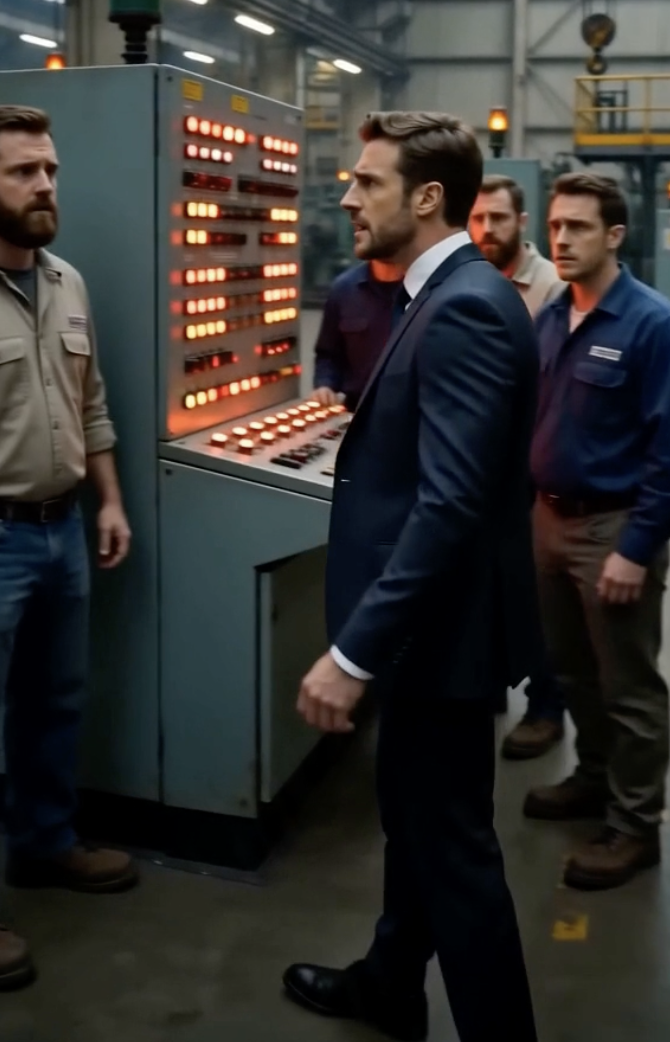
On the third morning, Daniel Mercer, the company’s new operations director, stood in front of the control panel surrounded by exhausted workers.
Daniel was thirty-eight, highly educated, and had been hired only six months earlier to modernize the aging plant.
He stared at the dark machine.
“We can’t keep losing money like this,” he said quietly.
One supervisor asked the question everyone was afraid to ask.
“What happens if we can’t restart it?”
Daniel hesitated.
“We close this production line.”
Nobody spoke.
That line employed one hundred and twelve people.
Several workers had spent their entire adult lives there.
Then a voice came from behind them.
“Did anyone check the secondary pressure relay?”
Everyone turned.
An elderly man in faded blue work clothes was walking across the factory floor.
His white hair was neatly combed, and he carried an old cloth rag in one hand.
Daniel frowned.
“Sir, you can’t be in here.”
A few older workers immediately recognized him.
“Walter?”
One man actually laughed with relief.
Walter stopped beside the control panel.
Daniel looked confused.
“Who is he?”
The supervisor smiled.
“The man who kept this place running before most of us knew how these machines worked.”
Daniel remained skeptical.
“We’ve had certified engineers working on this for two days.”
Walter nodded.
“I’m sure they’re very good.”
Then he pointed toward the enormous press.
“But that machine was built in 1974. Sometimes being very good isn’t the same as knowing what it remembers.”
Daniel stared at him.
“What does that mean?”
Walter approached the control console.
His fingers moved slowly across the old switches.
He didn’t press anything at first.
He simply listened.
The factory was almost silent except for ventilation fans and the faint hum of electricity.
Then Walter smiled.
“There it is.”
Daniel heard nothing.
“What?”
“The auxiliary pump.”
Walter pointed toward a row of lights.
“It’s running, but the main system doesn’t know it’s running.”
One engineer stepped closer.
“That’s impossible. The sensor says—”
“I know what the sensor says.”
Walter tapped the panel gently.
“But forty years ago, this machine had the same problem whenever the temperature dropped quickly overnight.”
Daniel looked toward the ceiling.
That weekend had been unusually cold.
Walter asked for permission before touching anything.
Daniel finally nodded.
The old man pressed two switches, waited several seconds, turned an emergency selector halfway, and then pressed a small green button that almost nobody used anymore.
For one second, nothing happened.
Then a deep metallic sound rolled through the building.
The hydraulic system came alive.
Lights across the control panel began turning green.
The enormous press moved.
Someone shouted.
Then the entire group erupted.
Workers clapped, laughed, and slapped each other on the shoulders.
Daniel simply stood there, staring at Walter.
“How did you know?”
Walter wiped his hands with the cloth.
“Because I made the same mistake in 1987.”
The laughter slowly faded.
Walter explained that the secondary pressure relay had once failed during a winter shift. The replacement system had never been fully integrated with the newer controls. Over the years, computer upgrades had hidden the old manual reset procedure.
The information had once been written in a maintenance notebook.
But when the factory digitized its records, that notebook disappeared.
Daniel looked embarrassed.
“We almost closed an entire line because we lost one piece of knowledge.”
Walter nodded.
“That happens when people think old information is useless just because it isn’t digital.”
Daniel expected Walter to leave after that.
Instead, he asked him to stay for lunch.
They talked for nearly two hours.
Daniel learned that Walter wasn’t angry about how the factory had changed. He understood that modernization was necessary.
But Walter said something Daniel never forgot.
“Machines can be replaced. Experience can’t. Not unless somebody passes it on.”
The next week, Daniel called Walter.
He offered him a consulting position.
Walter refused at first.
He was eighty-one. He had no desire to return to full-time work.
So Daniel offered something different.
Two mornings a week.
Walter would train younger technicians and help document the old systems that existed nowhere in the company’s computers.
Walter agreed.
Over the next eighteen months, he worked with a small team to create a complete technical archive of the factory.
Old notebooks were recovered.
Retired workers were interviewed.
Hundreds of procedures were recorded.
The company also created a mentorship program pairing experienced employees with younger engineers.
The production line never closed.
None of the one hundred and twelve workers lost their jobs.
Daniel eventually became plant director.
And Walter continued visiting every Tuesday and Thursday until he was eighty-four.
On his final day, the workers gathered beside the same enormous press.
Daniel handed him a framed photograph.
It showed Walter standing in front of the machine on the morning he had brought it back to life.
Underneath were the words:
“KNOWLEDGE KEEPS PEOPLE WORKING.”
Walter stared at the photograph for a long moment.
Then he looked around the factory where he had spent most of his life.
He thought about Margaret.
About the young man he had once been.
About all the people who had stood beside those machines before him and all the people who would stand there after him.
Then he smiled.
“I guess I finally finished my shift.”
Years later, the old press was replaced by a modern automated system.
But the small green button Walter had pressed that morning was removed from the original control panel and placed inside a glass case near the factory entrance.
Beside it was a simple plaque explaining what had happened.
Not because one old man had known which button to press.
But because he had reminded an entire company of something much more important:
Progress means very little if you forget the people who taught you how to move forward.