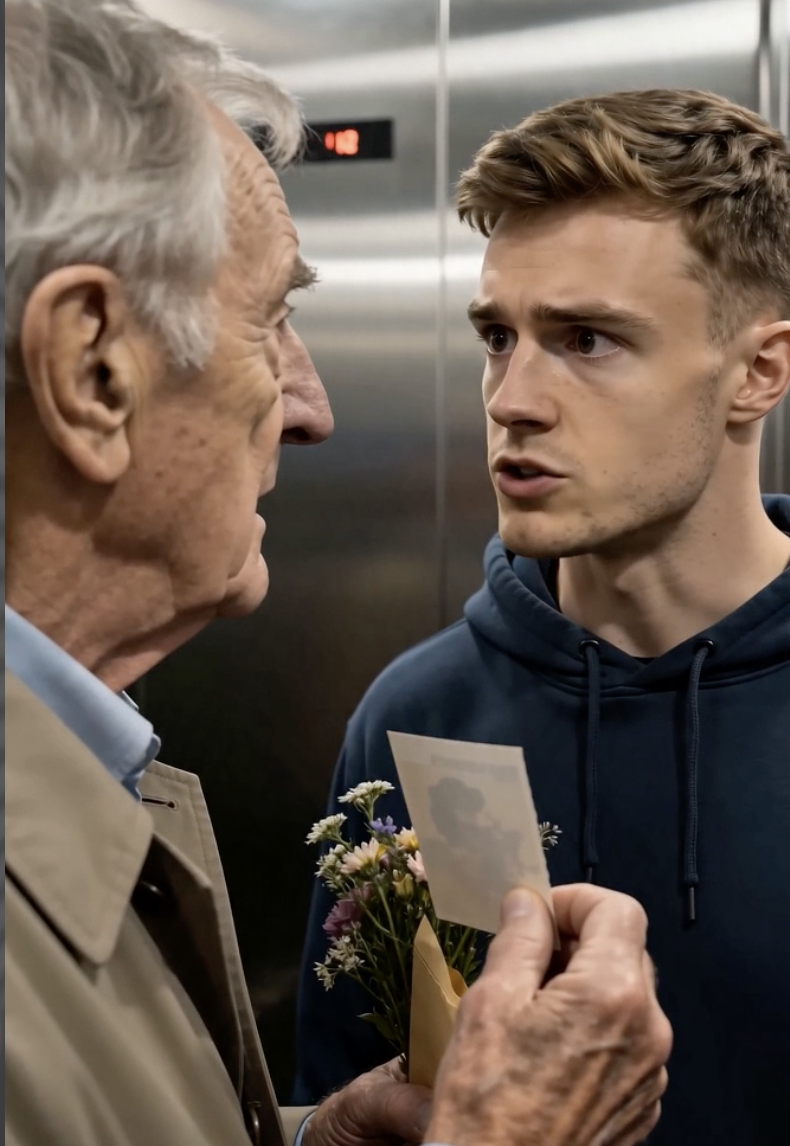
“Wait… Where did you get that photograph?”
Twenty-six-year-old Ethan stared at the elderly man standing beside him in the elevator.
The stranger was holding a small bouquet of wildflowers and a yellowed envelope. His hands trembled as he carefully removed an old black-and-white photograph.
In the picture was a beautiful young woman, smiling as she held a bunch of flowers.
Ethan felt his heart skip a beat.
“That woman… That’s my grandmother.”
The old man’s face went pale.
“Your grandmother?” he whispered. “Her name wouldn’t happen to be Margaret, would it?”
Ethan nodded.
The stranger gripped the photograph tighter.
“My name is Henry,” he said softly. “And I’ve been waiting fifty-eight years to see her again.”
But the story had begun long before that elevator ride.
In 1967, Henry was a twenty-year-old railway worker living in a small town in northern England.
He had almost nothing. His father had died when he was a teenager, and he worked long hours to help his mother pay the bills.
One rainy afternoon, he met Margaret.
She was eighteen, studying to become a nurse, and had the brightest smile he had ever seen.
They fell in love that summer.
Henry would bring her wildflowers because he couldn’t afford roses. Margaret would laugh and tell him that flowers picked with love were worth more than anything sold in a shop.
Every Sunday, they met beside the old railway station.
They dreamed of marrying, buying a little house, and growing old together.
But Margaret’s parents had other plans.
Her father had arranged for her to continue her studies in London. He believed Henry was too poor to offer his daughter a good future.
When Margaret refused to leave him, her father threatened to stop paying for her education.
Henry knew how much becoming a nurse meant to her.
So he made the hardest decision of his life.
He stepped aside.
Their final meeting was at the railway station.
Margaret cried as Henry handed her a small bouquet and promised he would always remember her.
Before boarding the train, she gave him a photograph.
“Keep this,” she whispered. “So you’ll know that someone once loved you more than anything.”
Henry kept that photograph for the rest of his life.
He wrote Margaret several letters, but after her family moved, they lost contact.
Years passed.
Henry eventually married a kind woman named Eleanor. They shared thirty-five happy years before she died. They had no children, but they built a life filled with friends, laughter, and affection.
Margaret also found happiness. She became a nurse, married a schoolteacher named Thomas, and raised two daughters.
Neither knew what had become of the other.
Yet Henry never threw away the photograph.
It wasn’t because he regretted his marriage. He loved Eleanor deeply.
He kept it because Margaret had been the first person to make him believe he deserved to be loved.
Then, almost sixty years later, everything changed.
Henry had recently discovered an old letter containing Margaret’s former address.
After years of wondering, he decided to visit, carrying the same kind of wildflowers he had given her as a young man.
That was why he stood inside the elevator that afternoon.
And that was how he met Ethan.
“Is she still living here?” Henry asked, his voice breaking.
Ethan lowered his eyes.
“My grandmother passed away three years ago.”
The elderly man’s shoulders sank.
For several seconds, neither spoke.
Then Henry whispered, “I came too late.”
Ethan looked at the flowers.
“Were you someone important to her?”
Henry gave a sad smile.
“I hope I was. A very long time ago.”
Ethan suddenly remembered something.
His grandmother had kept a small wooden box beneath her bed. Inside were photographs, old letters, and a faded train ticket.
He had never understood why she treasured them.
“Please,” Ethan said. “Come with me. There’s something you need to see.”
They went to Ethan’s apartment, where he carefully opened the box.
Among the old papers was a photograph of a handsome young man wearing a railway uniform.
Henry recognized himself immediately.
His hands began to shake.
Then Ethan found a letter, written in Margaret’s handwriting.
It was dated only a year before her death.
Henry slowly began reading.
“My dear Henry,
I don’t know where life has taken you, or whether you ever think of me.
I hope you’ve been happy. I truly do.
I married a wonderful man who gave me a beautiful family. I have children and grandchildren who fill my days with joy.
But I’ve never forgotten the boy who brought me wildflowers when he had nothing else to give.
You taught me that love sometimes means wanting someone to follow their dreams, even when it breaks your heart.
I hope someone has loved you as kindly as you loved me.
If we ever meet again, I hope we can sit together, drink tea, and remember that beautiful summer.
With love and gratitude,
Margaret.”
By the time Henry finished reading, tears were streaming down his face.
“She remembered me,” he whispered.
Ethan sat beside him.
“She never forgot you.”
Henry carefully placed the letter against his chest.
For fifty-eight years, he had wondered whether Margaret remembered their summer together.
Now he finally had his answer.
But their story did not end with sadness.
Over the following months, Ethan and Henry became close friends.
Every Sunday, Ethan visited the old man. They drank tea, looked through photographs, and talked about Margaret’s life.
Henry told stories about the girl she had once been. Ethan shared memories of the loving grandmother she had become.
Together, they filled the missing chapters of her life.
Ethan also learned about Eleanor, Henry’s late wife, and how much happiness their marriage had brought him.
For the first time in years, Henry no longer felt alone.
On what would have been Margaret’s eightieth birthday, Ethan took him to the cemetery.
Henry placed a bouquet of wildflowers beside her grave.
“Thank you for remembering me, Margaret,” he whispered. “I had a good life. I hope you know that.”
Ethan stood quietly beside him.
Then Henry reached into his coat and handed the young man the old photograph.
“I think this belongs with your family now.”
Ethan shook his head.
“No. Keep it. Grandma wanted you to have it.”
Henry smiled through his tears.
Five years later, Henry passed away peacefully at the age of eighty-five.
By then, Ethan had become the grandson he never had.
Ethan arranged for Henry to be buried beside Eleanor, the wife who had shared his life.
And among his most treasured belongings, the family found two photographs: one of Eleanor on their wedding day and another of Margaret holding wildflowers.
Ethan kept both pictures together in a beautiful wooden frame.
Years later, when his own daughter asked who the people in the photographs were, he told her the whole story.
He explained that Henry had loved two wonderful women in different chapters of his life, and that neither love diminished the other.
His daughter listened carefully before asking:
“Daddy, can someone really remember another person for almost sixty years?”
Ethan smiled.
“Yes, sweetheart. Sometimes people leave footprints on our hearts that time can never erase.”
And every spring, Ethan and his daughter brought wildflowers to the graves of Margaret, Eleanor, and Henry.
Three lives, connected by love, kindness, and memories that survived the passing years.
Because true love isn’t always about spending a lifetime together. Sometimes it’s about leaving someone with a beautiful memory that makes the rest of their life a little brighter.