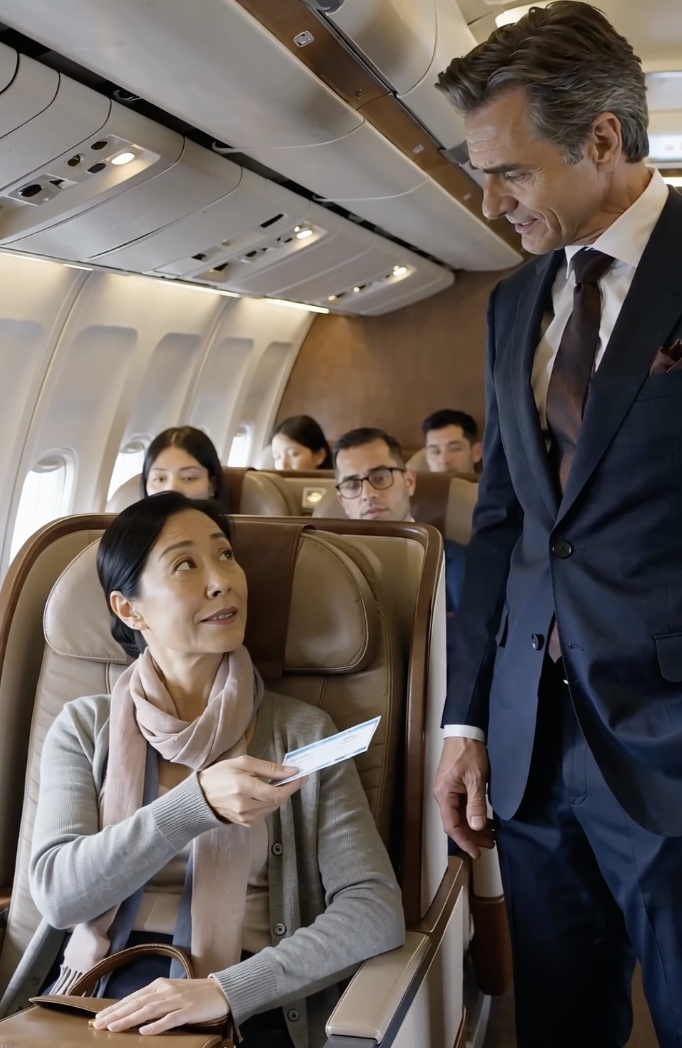
Michael Grant noticed the woman before he even reached his seat.
She sat quietly by the window in business class, both hands resting on an old brown handbag that looked strangely out of place among the polished leather seats and expensive luggage.
Michael checked his boarding pass again.
2A.
The seat where she was sitting.
He stopped beside her.
—Excuse me. I think you’re in my seat.
The woman looked up.
She was probably in her late sixties. Her gray cardigan was simple, and a pale scarf was wrapped neatly around her neck.
For several seconds, she simply stared at his face.
Then something changed in her expression.
—Michael?
He frowned.
—Do I know you?
The woman did not answer immediately.
Instead, she opened her handbag and carefully removed a small folded piece of paper.
Her hands trembled as she offered it to him.
—Your mother told me to give you this if I ever found you.
Michael froze.
His mother had been dead for thirty-two years.
He had been eight when she died.
The flight attendant standing nearby noticed his expression and quietly asked whether everything was all right.
Michael barely heard her.
He unfolded the paper.
The handwriting hit him harder than any voice could have.
He knew it.
His mother used to write his name on his lunch bags in exactly the same slanted letters.
At the top were two words:
My Michael.
Suddenly, the aircraft cabin seemed to disappear around him.
Michael had spent almost his entire adult life trying not to think about his childhood.
His mother, Sarah, had raised him alone.
They had lived in a tiny apartment where the heating failed every winter and rain leaked through the kitchen ceiling.
Yet Michael remembered being happy.
Sarah worked two jobs. During the day she cleaned rooms in a hotel. At night she worked in a small restaurant.
Whenever Michael asked why she was always tired, she would smile.
—Because tired is temporary. Your future isn’t.
Then she became ill.
At first she hid it.
By the time doctors discovered the cancer, there was little they could do.
Michael remembered the hospital.
The smell.
The white walls.
And the last afternoon when his mother held his hand and promised him he would never be completely alone.
Three days later, she died.
Michael was sent to live with relatives in another state.
Within months, almost everything from his old life disappeared.
By the time he became an adult, he had convinced himself that survival meant never looking backward.
He studied harder than everyone around him.
He built a technology company.
He became wealthy.
Then extremely wealthy.
At fifty-one, Michael owned homes in three countries and spent more nights in airplanes than in any of them.
People called him successful.
But he had no wife.
No children.
And almost no one he allowed close enough to hurt him.
Now an elderly stranger was holding a piece of his dead mother’s past.
Michael looked at her.
—Who are you?
Her eyes filled with tears.
—My name is Helen.
Then she told him.
Thirty-two years earlier, Helen had worked with Sarah at the hotel.
They became close friends.
When Sarah’s illness worsened, Helen began helping with Michael. She picked him up from school, cooked dinner and stayed with him when Sarah had hospital appointments.
Michael had been too young to remember her clearly.
But Sarah had trusted Helen with something important.
A letter.
She had written it for Michael shortly before she died.
Sarah believed Helen would be allowed to stay in his life.
But after the funeral, Michael’s relatives arrived suddenly and took him away.
There were arguments.
Addresses changed.
Phone numbers were disconnected.
Helen searched for him for years.
She contacted old relatives, schools and anyone she could find.
Nothing worked.
Eventually, Michael became successful enough that his face began appearing in newspapers and business magazines.
Helen finally knew where he was.
But by then she had lost her courage.
—Why didn’t you contact me? Michael asked.
She lowered her eyes.
—Because you looked like someone who had built a new life. I was afraid I would bring back a pain you had worked very hard to bury.
Michael looked down at the letter.
—And now?
Helen gave a small, sad smile.
—Now I’m sick.
She had been diagnosed with advanced heart disease six months earlier.
There was no dramatic cure waiting for her.
Doctors had told her that she might have a year.
Perhaps less.
Helen had spent months deciding what to do with the letter.
Finally, she learned that Michael would be traveling on this flight.
She used nearly all of her savings to buy a business-class ticket.
Not because she wanted luxury.
Because she knew it might be her last chance to sit close enough for him to notice her.
Michael slowly unfolded the rest of the letter.
His mother’s words were simple.
She wrote that she was sorry she would not see him grow up.
She told him she knew he would become strong.
But then came the sentence that broke something inside him:
“Please don’t become so strong that nobody can love you.”
Michael stopped reading.
For thirty-two years, he had believed that independence was the greatest gift he could give himself.
He never asked for help.
Never admitted fear.
Never stayed when relationships became complicated.
He had mistaken loneliness for strength.
His mother had understood the danger before he was old enough to understand it himself.
At the bottom of the letter, Sarah had written:
“Helen is family. If life ever brings you back to her, don’t lose her twice.”
Michael covered his mouth with his hand.
The flight attendant quietly moved away.
Helen looked toward the window, giving him the dignity of silence.
Then Michael sat down in the empty seat beside her.
He missed the meeting he had planned to work on during the flight.
For the next seven hours, he did not open his laptop once.
Instead, Helen told him everything he had forgotten.
How his mother used to sing while cleaning hotel rooms.
How she secretly saved coins in a coffee tin for Michael’s education.
How she once walked six miles home in the rain because she had spent her last few dollars buying him medicine.
And how, even when she knew she was dying, Sarah spoke more about her son’s future than her own fear.
When the plane landed, Michael did not allow Helen to disappear again.
He took her home himself.
Over the following year, he visited her every week.
Sometimes they talked about Sarah.
Sometimes they talked about nothing important at all.
Michael also began changing his own life.
He reduced his travel.
He called people he had pushed away.
He apologized to his younger cousin after eleven years of silence.
And, for the first time in decades, he stopped treating affection as something dangerous.
Helen lived fourteen months after that flight.
Michael was beside her when she died.
On her final evening, she asked him one question.
—Do you still feel alone?
Michael held her hand.
—No.
Helen smiled.
—Then I kept my promise to your mother.
After her death, Michael created a scholarship in Sarah and Helen’s names for children being raised by single parents.
He later married a woman he had known for years but had never previously allowed himself to love fully.
They had a daughter.
Michael named her Sarah.
He kept his mother’s original letter framed inside his study.
Decades later, when his daughter asked why an old folded piece of paper mattered so much, Michael told her the whole story.
Then he pointed to the final sentence.
“Don’t lose the people who love you just because you learned how to survive without them.”
The small note had spent thirty-two years inside an old handbag.
It had crossed cities, decades, grief and silence before finally reaching him thirty thousand feet above the ground.
Michael had boarded that plane believing he already had everything he had ever wanted.
He stepped off it knowing how wrong he had been.
Because the most valuable thing waiting for him that day had not been a business deal, a first-class seat or another destination.
It was the last piece of his mother’s love, carried patiently through thirty-two years by a woman who had refused to throw it away.