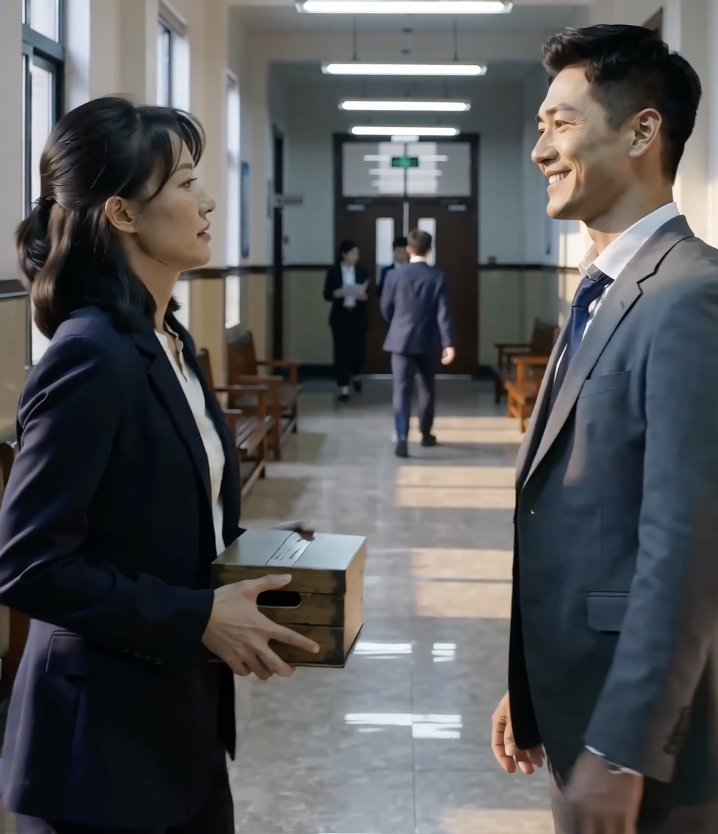
Daniel Carter was already late for court when the woman stepped in front of him.
He knew her face. Her name was Rebecca Miles, and she worked in the records department of the county courthouse. They had exchanged polite greetings for years, but never more than that.
That morning, however, Rebecca was holding an old wooden box against her chest.
—Mr. Carter, I need five minutes.
Daniel glanced at his watch.
—Can it wait?
—No.
There was something in her voice that made him stop.
Rebecca held out the box.
—This belongs to you.
Daniel almost smiled.
—I’ve never seen it before.
—You have. You just don’t remember.
That sentence erased the impatience from his face.
He slowly took the box.
It was heavier than it looked. The wood was scratched, and one corner had been repaired with a thin metal strip.
When Daniel opened the lid, the hallway seemed to go silent.
Inside were a pair of tiny white baby shoes.
Beneath them lay yellowed pieces of paper, an old hospital bracelet and several handwritten letters tied together with a faded ribbon.
Daniel stared at the bracelet.
A name had been written across it.
Baby Carter.
His hands began to tremble.
—Where did you get this?
Rebecca took a breath.
—From a sealed adoption file.
Daniel looked up sharply.
—I’m not adopted.
Rebecca’s expression answered him before she spoke.
—Yes, Daniel. You are.
For forty-three years, Daniel had believed he knew exactly where he came from.
His parents, Richard and Margaret Carter, had raised him in a beautiful house outside Boston. Richard was a respected attorney. Margaret taught literature at a private school.
They gave Daniel everything.
The best education.
Summer trips.
Music lessons.
A place at one of the country’s finest universities.
But there had always been something strangely distant in their home.
They loved him, Daniel knew that.
Yet childhood questions were often answered with silence.
There were no photographs of Margaret pregnant with him.
No stories about the day he was born.
Whenever Daniel asked why he looked nothing like anyone in the family, his father laughed and said:
—Genes are unpredictable.
Daniel eventually stopped asking.
Richard died when Daniel was thirty-four.
Margaret died six years later.
Whatever secrets they had carried disappeared with them.
Or so Daniel believed.
Rebecca pointed toward the letters.
—Your biological mother left those for you.
Daniel did not touch them.
—She abandoned me.
Rebecca shook her head.
—That’s not what happened.
Her name had been Emily Dawson.
She was seventeen when Daniel was born.
Her family was poor, deeply religious and terrified of scandal. The baby’s father was an eighteen-year-old boy named Samuel Reed, who had planned to marry her.
But Emily’s parents refused.
They sent her away during the pregnancy.
When Daniel was born, Emily was told that the baby had been placed with a family who could give him a better life.
She begged to keep him.
She begged to see him one last time.
She was allowed only ten minutes.
During those ten minutes, she put the tiny white shoes beside him and wrote the first letter.
Then Daniel was taken away.
Richard Carter had handled the adoption.
Months later, he and Margaret unexpectedly became Daniel’s adoptive parents after the original placement collapsed.
The adoption was legal.
But Richard made one decision that would shape the next four decades.
He sealed every connection to Emily.
She wrote letters.
He never delivered them.
At first, he told himself he was protecting Daniel from confusion.
Later, he was simply afraid.
Afraid that Daniel would discover another mother existed.
Afraid that love might be divided.
Afraid that one day his son might leave.
Emily wrote every birthday.
At one year old.
At five.
At ten.
At sixteen.
At twenty-one.
She never knew whether Daniel had read a single word.
He hadn’t.
Rebecca had found the box only because the courthouse was digitizing records from several decades earlier.
Inside Richard Carter’s private legal archive was a handwritten instruction:
“If Daniel ever requests information regarding his birth, release this box to him.”
Daniel laughed once, bitterly.
—So even in the end, he made it my responsibility to ask a question I didn’t know existed.
Rebecca said nothing.
Daniel lifted the first letter.
The handwriting was young and uneven.
He began reading.
Emily did not ask him to forgive her.
She did not claim to deserve a place in his life.
She only wanted him to know one thing:
She had not given him away because she did not love him.
She had been a frightened seventeen-year-old girl surrounded by adults who made every decision for her.
In another letter, written when Daniel turned ten, she described seeing a boy with dark hair at a train station and following him for several steps because, for one impossible second, she thought it might be her son.
At eighteen, she wrote:
“You are old enough now to choose your own life. I hope nobody ever takes that choice away from you the way mine was taken from me.”
Daniel stopped reading.
His eyes filled with tears.
Then he asked the question he was suddenly terrified to ask.
—Is she alive?
Rebecca nodded.
—She is.
Daniel closed his eyes.
Emily was sixty years old and living in a small coastal town in Maine.
She had become a nurse.
She had married in her thirties but never had another child.
Her husband had died five years earlier.
And every year, on Daniel’s birthday, she still wrote one letter she never expected him to read.
Daniel did not go to court that morning.
For the first time in twenty years, he walked away from a case without caring what anyone thought.
Three days later, he drove to Maine.
Emily lived in a modest blue house overlooking the sea.
Daniel remained inside his car for nearly twenty minutes before finding the courage to knock.
A woman with silver in her hair opened the door.
Neither of them spoke.
Emily looked at his face.
Then at the wooden box in his hands.
Her knees almost gave way.
—Daniel?
He nodded.
She covered her mouth.
—I thought I’d die without ever hearing you say your name.
Daniel had imagined being angry.
He had prepared questions.
Why didn’t you fight harder?
Why didn’t you find me?
Why did everyone decide my life without asking me?
But when he saw her standing there, he saw no woman who had abandoned a child.
He saw the seventeen-year-old girl from the letters, aged by forty-three years of waiting.
So he asked only:
—Do you still remember those shoes?
Emily began to cry.
—Every day.
Daniel opened his arms.
She stepped into them.
Their first embrace lasted almost a minute.
It did not erase forty-three years.
Nothing could.
But it ended them.
Daniel spent the next years learning his mother instead of mourning the years he had lost.
Emily told him about Samuel, his biological father, who had died in an accident at thirty-two but had never stopped asking about the son he was forbidden to see.
Daniel visited Samuel’s grave.
He brought one of the letters and read it aloud.
He also made peace, slowly, with Richard and Margaret.
They had loved him.
Richard had also made a selfish choice out of fear.
Both things were true.
Daniel no longer needed one truth to destroy the other.
Emily lived another nineteen years.
She saw Daniel marry.
She held his newborn daughter.
And when Daniel and his wife asked what they should name the baby, he already knew the answer.
Emily.
His mother laughed through her tears.
—One Emily in this family has caused enough trouble.
Daniel kissed her forehead.
—Then this one gets to start without any secrets.
When Emily died at seventy-nine, Daniel was holding her hand.
The old wooden box remained in his home.
He placed the baby shoes back inside, along with every letter his mother had written.
But he added one final letter of his own.
It began:
“Mom, your letters finally found me.”
Years later, Daniel gave the box to his daughter.
He told her the entire story.
No softened version.
No hidden names.
No sealed doors.
Because Daniel had learned that family secrets rarely disappear.
They simply wait for the next generation to open them.
For forty-three years, he had believed his life began with two parents who chose him.
That was true.
But it was not the whole truth.
His life had also begun with a frightened seventeen-year-old mother placing two tiny white shoes beside her newborn son and praying that somehow, someday, he would understand.
Forty-three years later, he finally did.