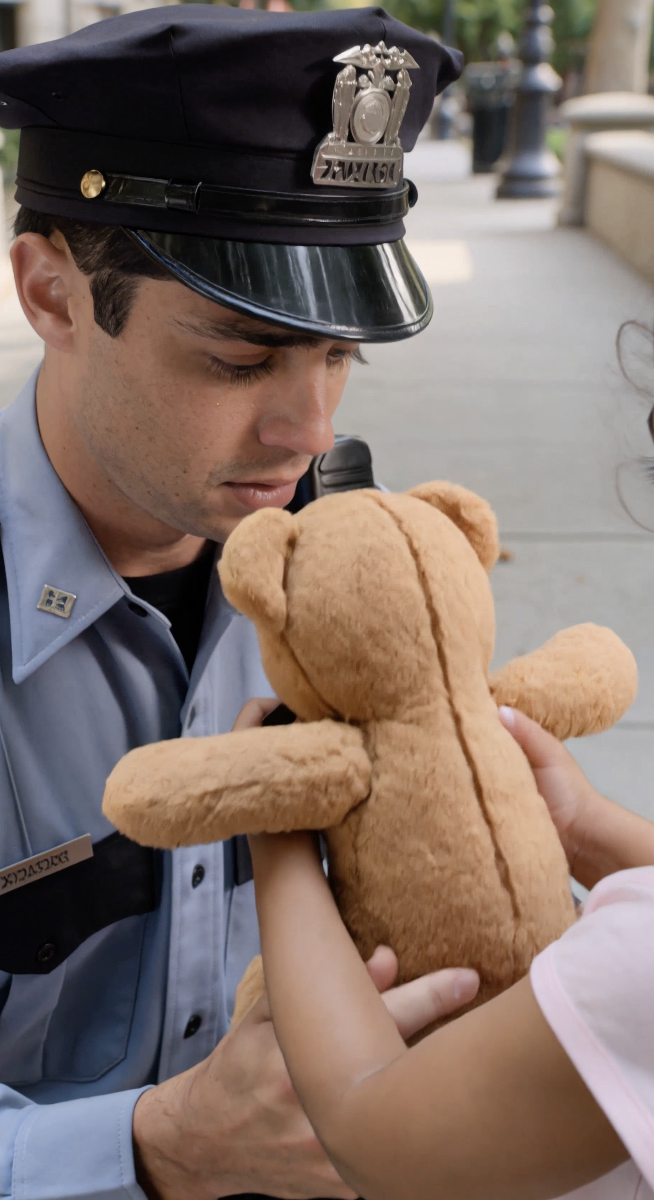
Officer Daniel Reed had learned long ago not to carry his past into uniform.
For twelve years, he had walked the same city streets, answered calls, broken up fights, helped strangers find their way home, and told frightened children that everything was going to be all right.
Most days, he believed those words himself.
But there was one person Daniel had never been able to bring home.
His younger sister, Grace.
They had grown up in a house where love existed, but peace rarely did. Their father drank too much and apologized too little. Their mother spent years trying to hold the family together until illness took her when Daniel was twenty-one and Grace was seventeen.
After the funeral, everything fell apart.
Daniel joined the police academy. Grace wanted to leave the city.
He thought she was running away from responsibility.
She thought he was becoming exactly like their father—someone who confused control with protection.
Their final argument happened on a rainy November night.
Grace stood in the doorway with one suitcase.
“I need to find out who I am somewhere that doesn’t know our family,” she told him.
Daniel was angry, exhausted, and terrified of losing the only family he had left.
Instead of admitting that, he said the worst thing he could have said.
“If you walk out now, don’t expect me to come looking for you.”
Grace stared at him for a long moment.
Then she left.
Daniel regretted the sentence before the door had even finished closing.
But pride can keep people silent long after anger disappears.
He called a few weeks later.
Her number had changed.
He sent emails that were never answered. He searched social media, asked old friends, even contacted people she had once worked with.
Nothing.
Years passed.
Daniel became a good police officer.
Then a sergeant.
He helped hundreds of families reunite.
Yet every Christmas he still set his phone on the table beside him, secretly hoping an unknown number would appear.
It never did.
Until one warm afternoon in early September, when he saw a little girl standing alone on a crowded sidewalk.
She looked about seven.
She wore a pale pink shirt and held a worn brown teddy bear tightly against her chest. People moved around her, but she remained completely still, trying very hard not to cry.
Daniel immediately crouched so they were at eye level.
“Hey,” he said gently. “Are you lost?”
The girl shook her head, then nodded.
Daniel smiled.
“That’s okay. We can figure it out together.”
She studied his face.
Not his badge.
Not his uniform.
His face.
Then she asked something that made him pause.
“Are you Officer Daniel Reed?”
His smile disappeared.
“Yes.”
The little girl suddenly hugged the teddy bear harder.
“My mom said you might look older now.”
Daniel felt something cold move through his chest.
“What’s your name?”
“Lucy.”
“And what’s your mom’s name?”
The child hesitated, as though she had been given instructions she was trying desperately to remember.
Then she reached into the small pocket sewn into the teddy bear’s back.
She pulled out a phone.
“My mom told me that if something happened and I couldn’t find her, I should show you this.”
Daniel took the phone.
There was no password.
Only one photograph open on the screen.
He stared at it.
For several seconds, the noise of the city seemed to vanish.
Two teenagers were sitting on the hood of an old blue car.
A seventeen-year-old girl was laughing at the camera.
Beside her stood Daniel at twenty-one, one arm around her shoulders.
Grace.
The photograph had been taken three weeks before their mother died.
Daniel had not seen it in more than a decade.
His hands began to tremble.
He looked at Lucy again.
The shape of her eyes.
The slight dimple in her left cheek.
He had seen both before.
Every morning of his childhood.
“Grace is your mother?”
Lucy nodded.
Daniel had faced armed men without feeling his knees weaken.
Now he had to put one hand against the pavement to steady himself.
“Where is she?”
Lucy pointed toward the end of the street.
“She fell down.”
Daniel’s training returned instantly.
He called for medical assistance and took Lucy by the hand.
They found Grace less than two blocks away.
She was sitting against the wall of a pharmacy, pale and shaking, surrounded by two strangers who had stopped to help. She had fainted after a sudden drop in blood pressure. She was conscious again, but an ambulance was already on its way.
Daniel stopped several feet from her.
Grace looked up.
Twelve years disappeared from both their faces.
Neither moved.
Grace was thirty-nine now. Her hair was shorter. There were fine lines around her eyes that Daniel did not remember.
But she was still his little sister.
Lucy ran toward her.
“Mom!”
Grace pulled her daughter close.
Then her eyes returned to Daniel.
“I wondered if she’d find you,” she whispered.
Daniel could barely speak.
“You knew I was here?”
Grace nodded.
“Always.”
That answer hurt more than if she had said no.
“Then why didn’t you call?”
Grace looked at Lucy before answering.
“Because every year I waited, it became harder.”
Daniel understood immediately.
It was exactly what had happened to him.
After leaving, Grace had moved to Boston with a friend. She had found work, returned to school, and eventually married a man named Andrew Parker.
She had almost called Daniel on her wedding day.
She had almost called when Lucy was born.
She had almost called when Andrew died from cancer two years earlier.
Almost.
Again and again.
But she had kept remembering Daniel’s final words.
Don’t expect me to come looking for you.
What Grace never knew was that Daniel had searched.
His messages had gone to an email account she had stopped using. The friend who knew her new address had moved overseas. Their attempts to find each other had passed like trains on different tracks.
Months before that afternoon, Grace had finally decided to return to the city.
Not only for herself.
For Lucy.
Her daughter had begun asking why she had no grandparents, no uncles, no family stories from her mother’s childhood.
Grace realized she was about to teach Lucy the same lesson that had destroyed her own family: that silence was safer than forgiveness.
So she showed her daughter Daniel’s photograph.
She told her his full name.
And she explained that if they found him, Lucy would finally meet her uncle.
She simply had not expected it to happen while she was lying unconscious on a sidewalk.
At the hospital, doctors confirmed that Grace would be fine.
Daniel sat beside her bed while Lucy slept in a chair with the teddy bear under her chin.
Brother and sister talked until after midnight.
They talked about their mother.
Their father.
The night Grace left.
Daniel told her he had regretted his words every day since.
Grace admitted that she had spent years waiting for him to somehow prove he wanted her back, while doing everything possible to remain impossible to find.
Neither blamed the other entirely.
Neither pretended twelve lost years could disappear in one conversation.
But before Daniel left the room, Grace reached for his hand.
“Come tomorrow.”
It was not forgiveness.
Not yet.
It was something more useful.
A beginning.
Daniel came the next morning.
Then the day after that.
When Grace and Lucy moved into a small apartment nearby, he helped carry the boxes.
He became the uncle Lucy had heard stories about but never expected to meet. He attended her school performances, taught her to ride a bicycle, and developed the habit of bringing her hot chocolate whenever he finished an evening shift.
Grace eventually returned to work as a physical therapist.
She never left the city again.
Brother and sister still argued sometimes.
But they made themselves one promise:
No disappearing.
No punishment through silence.
If they were angry, they spoke.
If they were hurt, they said so.
If they loved each other, they did not assume there would always be another year in which to prove it.
Seven years later, Lucy graduated from middle school.
After the ceremony, she ran across the courtyard and threw her arms around Daniel.
She was taller now. The old teddy bear had long since been placed on a shelf in her bedroom.
But the photograph from the phone had been printed and framed.
Daniel kept a copy in his apartment.
Beside it stood another photograph.
Grace, Lucy, and Daniel together.
On the back, Grace had written one sentence:
Some families find their way home late. What matters is that they stop walking away from each other.
Daniel never forgot the afternoon a frightened little girl stood before him holding a teddy bear and spoke his name.
He had spent twelve years believing he had failed to find his sister.
In the end, it was her daughter who found him.
And when Lucy wrapped her arms around him that day, Daniel understood something he would carry for the rest of his life.
Sometimes the person you think you have lost forever is not waiting for a miracle.
They are waiting for one of you to finally cross the distance.
This time, Daniel did.
And neither of them ever let that distance grow between them again.