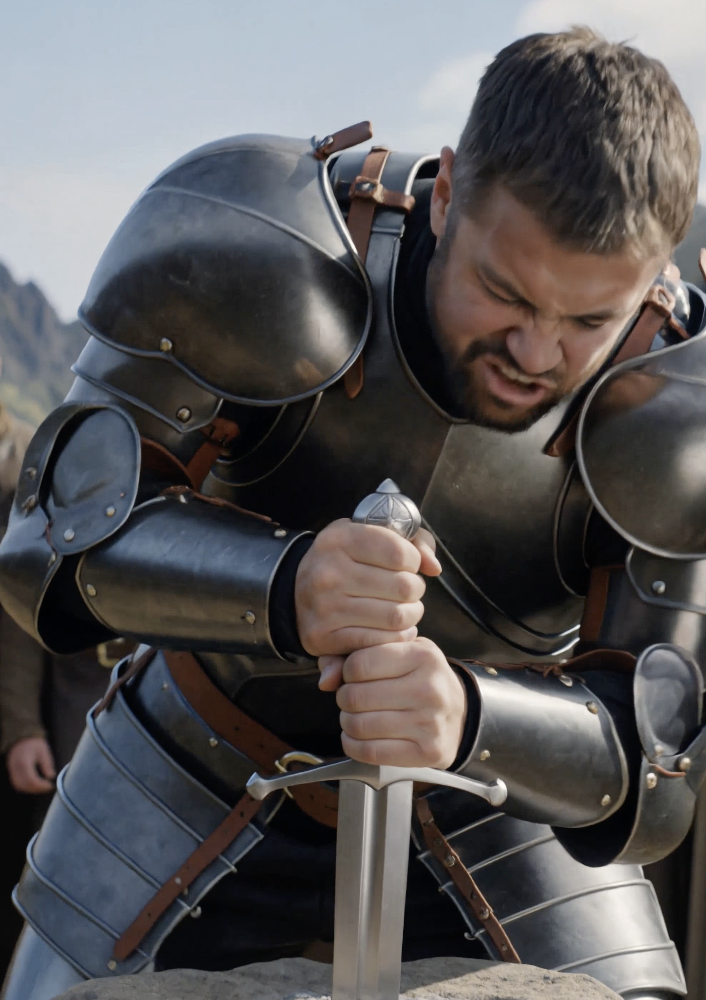
For twelve years, the people of Valen had believed that only a great warrior could remove the silver sword buried in the stone at the center of the mountain pass.
The weapon had belonged to King Aldric, the last ruler of the valley.
Before his death, Aldric had ordered the sword placed inside the stone and left only one message:
“The one worthy to protect my people will be able to lift it.”
Since then, dozens of soldiers, noblemen and mercenaries had tried.
All had failed.
But no one doubted Sir Garrick Vale.
Garrick was the strongest knight in the region. He had won tournaments, led armies and spent years telling everyone that strength was proof enough that he deserved to become the valley’s next lord.
On the morning of the ceremony, hundreds gathered between the mountains.
Garrick stepped toward the stone in polished black armor.
Among the villagers stood a thin eleven-year-old boy named Elias.
Elias had grown up poor.
His mother, Mara, repaired clothes for farmers, while Elias carried wood, cleaned stables and accepted any work that brought home a few coins.
His father, Tomas, had once been the royal blacksmith.
But Elias barely remembered him.
When the boy was four, Tomas was accused of helping enemies steal weapons from the king’s armory. He was imprisoned and died before his name could be cleared.
For years, people whispered whenever Elias walked past.
“That’s the traitor’s son.”
Mara always told him the same thing.
“Your father made mistakes, Elias. But treason was not one of them.”
Elias wanted to believe her.
He simply had no proof.
That morning, Sir Garrick wrapped both hands around the sword.
He pulled.
Nothing happened.
His face reddened.
He pulled harder.
The crowd went silent.
Garrick shouted and used every bit of his strength, but the blade did not move even a finger’s width.
Finally, furious and humiliated, he released it.
Someone in the crowd laughed.
Garrick turned sharply.
That was when he noticed Elias.
The boy was staring at the sword.
Not at Garrick.
At the handle.
Elias had seen the small symbol carved into it.
A tiny bird surrounded by three stars.
His father used to carve the same mark into every tool he made.
Elias slowly stepped forward.
Garrick blocked him.
— Go back to your mother.
Elias swallowed.
— My father made that sword.
The crowd erupted in whispers.
Garrick laughed.
— Your father was a traitor.
— No.
For the first time in his life, Elias said the word loudly enough for everyone to hear.
— He wasn’t.
An elderly man pushed through the crowd.
It was Brother Ansel, the former keeper of the royal archives.
He stared at the symbol on the sword and then at Elias.
— Let the boy try.
Garrick’s expression hardened.
— This is not a game.
— Neither was King Aldric’s final command.
Reluctantly, Garrick moved aside.
Elias approached the stone.
His hands trembled as he wrapped them around the handle.
He expected laughter.
He expected nothing to happen.
Instead, the moment his fingers touched the metal, something clicked inside the stone.
Elias pulled.
The sword came free.
Not with thunder.
Not with magic or fire.
Simply with the clean sound of metal sliding from stone.
Nobody spoke.
Elias himself looked terrified.
Then Brother Ansel began to cry.
He explained what had really happened twelve years earlier.
King Aldric had never created a test of physical strength.
The sword contained a mechanism built by Tomas.
Before the king died, he had discovered that several nobles were secretly selling weapons to raiders.
Tomas had uncovered the scheme.
Sir Garrick’s father was among those involved.
To silence Tomas, they accused him of the very crime he had discovered.
King Aldric learned the truth too late.
Before his death, he ordered Tomas to build the sword mechanism.
It could only be released when pressure was placed on a tiny hidden plate beneath the bird symbol.
Tomas had designed it so that only someone who knew his craftsman’s mark would notice where to place a thumb.
The sword was never meant to choose a king.
It was meant to reveal the truth when Tomas or someone he trusted returned.
But Tomas died in prison before that could happen.
Mara covered her mouth as tears ran down her face.
Elias looked at the weapon in his hands.
For seven years he had carried another man’s shame.
In less than a minute, it disappeared.
Sir Garrick tried to leave, but Brother Ansel had brought more than a story.
He had preserved letters, payment records and the king’s sealed testimony.
The documents proved that Garrick’s father and several other nobles had organized the thefts.
Garrick himself had known part of the truth for years and had remained silent because exposing it would have destroyed his family’s reputation.
He was stripped of his position.
But Elias did not become king.
When the council offered his family land and money as compensation, Mara accepted only enough to give Elias an education and rebuild Tomas’s old workshop.
Elias grew up learning metalwork.
At eighteen, he became the youngest master smith in Valen.
At twenty-six, he was elected to the valley council—not because of the sword, but because people trusted the quiet young man who listened before he spoke.
Years later, Elias placed the famous sword inside the town hall.
Beside it he hung a small plaque bearing his father’s name:
“Tomas of Valen. Royal Smith. Falsely accused. His honor restored.”
Mara lived long enough to see it.
Before she died, she stood beside her son and touched the inscription.
— I told you your father wasn’t a traitor.
Elias smiled through his tears.
— I know.
The sword remained in Valen for generations.
People stopped telling the story as a legend about a boy stronger than a knight.
Because Elias had never been stronger than Garrick.
That had never been the point.
The strongest man in the valley had tried to force the sword from the stone.
A poor boy had simply understood what everyone else had ignored.
And sometimes, history does not change because the strongest person wins.
Sometimes it changes because the truth finally finds the right hands.