Seven years earlier, Daniel Whitmore lost his wife, Emma, in a car accident that left their only daughter, Sophie, with a permanent spinal injury.
Sophie was six at the time.
Daniel spent the following years rebuilding their lives around hospital appointments, rehabilitation, school, and the quiet grief neither of them knew how to name.
Then Daniel met Charlotte.
At first, Charlotte seemed patient and loving. She helped Sophie with homework, attended family dinners, and repeatedly told Daniel that she understood Sophie would always come first.
That was why Daniel never imagined that, behind his back, Charlotte had begun treating his daughter as an obstacle to the perfect new life she wanted.Daniel Whitmore noticed something was wrong with his daughter before the wedding dinner had even begun.
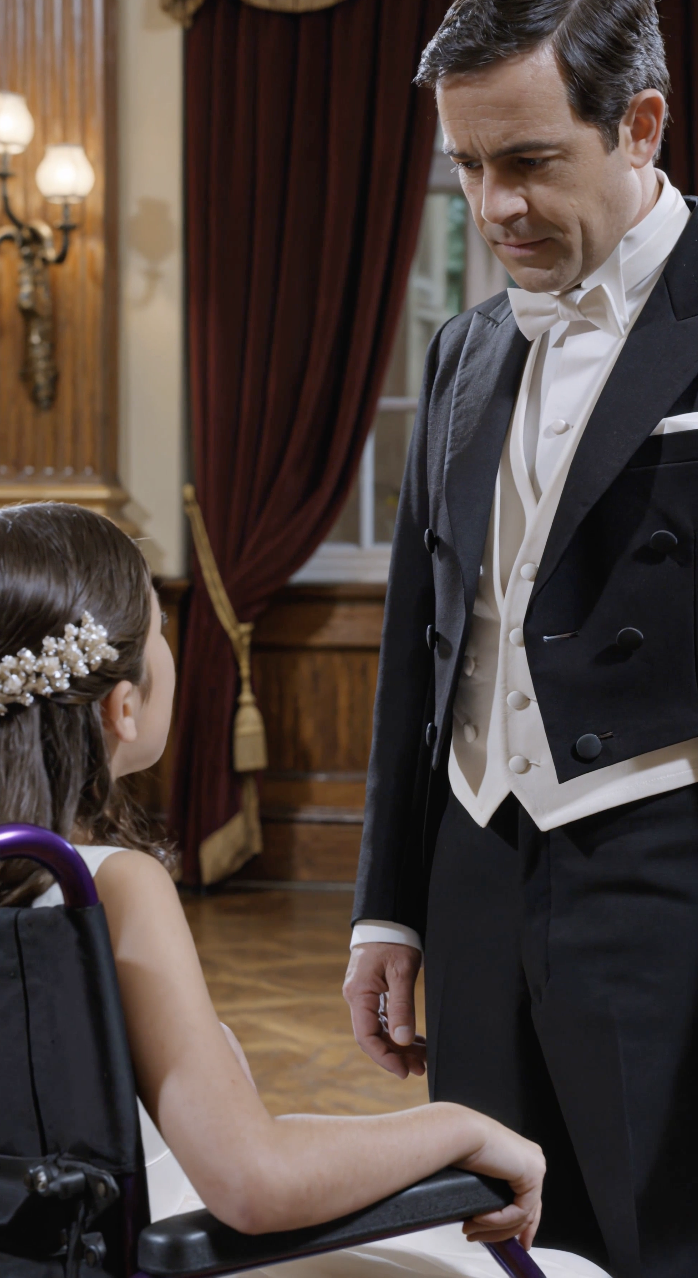
Sophie sat quietly in her wheelchair near the edge of the ballroom, dressed in the ivory gown she had chosen months earlier.
She was supposed to be beside him.
Instead, she looked as though she wanted to disappear.
Daniel crossed the room.
“Hey,” he said softly. “Why are you sitting over here?”
The eleven-year-old looked toward Charlotte, Daniel’s new wife, who was speaking with guests across the room.
Then Sophie lowered her voice.
“Dad… was I supposed to come today?”
Daniel stared at her.
“What?”
Sophie swallowed.
“Charlotte said there wasn’t really a place for me.”
For several seconds, Daniel thought he had misunderstood.
This wedding had been planned around Sophie from the beginning.
She had helped choose the flowers. Daniel had promised she would sit at the family table. During the ceremony, she was supposed to carry the rings in a small velvet box.
But that morning Charlotte had suddenly announced that one of her cousins would carry them instead.
She had called it a “last-minute change.”
Daniel had been too distracted to question it.
Now he crouched beside Sophie.
“What exactly did she say?”
Sophie hesitated.
Then she reached beneath the blanket over her knees and pulled out an old-fashioned cream card.
It was the original seating plan.
Daniel recognized Charlotte’s handwriting immediately.
Several names were arranged beneath the heading “Family Table.”
Charlotte.
Daniel.
Charlotte’s mother.
Her sister.
Her brother.
Then there was Sophie’s name.
Crossed out.
Beside it, someone had written:
“Move to side table — wheelchair ruins spacing/photos.”
Daniel read the sentence twice.
His hands began to shake.
“Where did you get this?”
“It was on the desk upstairs,” Sophie whispered. “I wasn’t trying to look. Charlotte told me this morning that I should stay near the wall because the photographer needed the center clear.”
Daniel looked toward his bride.
Charlotte was smiling for a photograph.
Everything suddenly made sense.
For months she had suggested that Sophie might be “more comfortable” spending weekends with Daniel’s parents.
She had wanted a honeymoon that lasted six weeks.
She had complained that the new house Daniel was buying had “too many expensive modifications” for a child who would eventually become independent.
Each comment had seemed small on its own.
Together, they formed something Daniel could no longer ignore.
He stood.
Charlotte saw his expression and immediately walked toward him.
“Daniel? What happened?”
He held up the card.
Her face changed.
Only for a second.
But he saw it.
“What is this?”
Charlotte glanced at Sophie.
“That’s an old draft.”
“Why is my daughter’s name crossed out?”
“I was trying to organize the room.”
“And this?”
He pointed to the handwritten note.
Charlotte’s voice dropped.
“Daniel, please. Not here.”
That sentence decided everything.
Not because she had made a seating mistake.
Because she was more worried about being embarrassed in front of the guests than about the little girl sitting three feet away.
Sophie stared at the floor.
Charlotte leaned closer.
“We can discuss this privately.”
“No,” Daniel said.
The music continued behind them, but the people nearest the family table had begun to notice.
Charlotte whispered angrily:
“You’re making this into something it isn’t.”
Daniel looked at Sophie.
“No. I think I’ve spent months pretending it wasn’t what it was.”
Charlotte’s mother approached, demanding to know what was happening.
Daniel handed her the card.
Her expression went blank.
Then Daniel removed the microphone from the stand prepared for the speeches.
He did not humiliate Charlotte.
He did not read the note aloud.
He simply told the guests that the reception was ending early because he had discovered something about the marriage that he could not ignore.
Charlotte followed him into the corridor.
“You’re destroying our wedding over one stupid sentence?”
Daniel stopped.
“No. I’m ending a marriage because that sentence tells me how you see my child when I’m not watching.”
Charlotte cried.
She apologized.
She insisted she had only wanted one perfect photograph.
But Daniel finally understood the problem.
Sophie was not an accessory to his life.
She was his family.
And anyone who needed Sophie hidden in order to create a “perfect” family picture did not belong in that family.
Daniel had the marriage annulled as soon as legally possible.
The following months were painful.
Sophie blamed herself at first.
Daniel made sure she understood the truth.
“You didn’t ruin anything,” he told her. “You showed me something I needed to see.”
He also apologized for missing the earlier signs.
A year later, Daniel and Sophie moved into the accessible home he had originally planned to buy. Sophie returned to swimming therapy, joined her school’s art club, and eventually became known for the sharp, funny illustrations she posted online.
Daniel did not date seriously again for several years.
When he eventually met Rachel, a pediatric architect, he introduced her to Sophie without promises or pressure.
Rachel never tried to replace Emma.
She never asked Sophie to disappear from photographs.
Three years later, when Daniel and Rachel married in a small garden ceremony, Sophie was fourteen.
This time there was no complicated seating chart.
Sophie sat directly beside her father.
Before the photographer took the family portrait, Daniel moved behind her wheelchair and placed one hand on her shoulder.
Rachel stood beside them.
Nobody was pushed to the edge.
Nobody was hidden.
Daniel kept the old cream seating card in a drawer for years.
Not because he wanted to remember Charlotte.
Because on the hardest day of his life, his daughter had unknowingly taught him something he would never forget:
A family photograph is not perfect because everyone looks perfect.
It is perfect when nobody you love has been asked to disappear from it.